


Las Vegas Marijuana DUI Attorney
Related Practice Areas
Other Practice Areas
Understanding Marijuana DUI Charges in Nevada
Nevada legalized recreational marijuana in 2016 and medical marijuana in 2001. But legal access has not changed the state’s position on impaired driving. It is still a crime to drive under the influence of marijuana in Nevada, and the state enforces some of the strictest THC-related driving laws in the country.
Nevada is one of a small number of states with a per se marijuana DUI law. Under NRS 484C.110(3), if a blood test shows that a driver has 2 nanograms per milliliter of delta-9-THC or 5 nanograms per milliliter of marijuana metabolite (11-OH-THC), the driver is presumed impaired and will be charged with a marijuana DUI, regardless of whether they were actually impaired at the time. This means a regular marijuana user can be over the legal limit even when they are not high, because THC metabolites remain in the body long after the intoxicating effects have worn off.
If you are facing a marijuana DUI charge in Nevada, the consequences are the same as those for an alcohol-based DUI, including potential jail time, license suspension, fines, and a criminal record. At Spartacus Law Firm, founding attorney Chandon S. Alexander has defended hundreds of DUI and DUID cases in Clark County. As a recognized member of the National Trial Lawyers Top 10 Under 40, Chandon brings aggressive, detail-driven defense strategies to every marijuana DUI case. Call (702) 660-1234 for a consultation.
How Nevada Defines a Marijuana DUI
Under NRS 484C.110, a driver is guilty of a marijuana DUI if any of the following conditions are true at the time of arrest:
- Per se blood limits: The driver’s blood contains 2 nanograms per milliliter of marijuana (delta-9-THC) or 5 nanograms per milliliter of marijuana metabolite (11-OH-THC)
- Per se urine limits: The driver’s urine contains 10 nanograms per milliliter of marijuana or 15 nanograms per milliliter of marijuana metabolite
- Impairment standard: The driver ingested marijuana to a degree that rendered them incapable of safely driving or exercising actual physical control of a vehicle
Because these thresholds are based on the amount of marijuana found in blood or urine, a driver can be arrested and charged with a marijuana DUI even if they are not actively high at the time of the stop. THC metabolites can remain detectable in the body for days or even weeks after use, particularly in regular users. This creates situations where a person who used marijuana days ago and is completely sober can still test above the legal limit. Understanding this distinction is critical, and it is one of the primary defense angles an experienced Las Vegas DUI attorney can use to fight your charge.

Marijuana DUI Penalties in Nevada
Marijuana DUI penalties mirror those for alcohol-based DUI charges. The severity depends on the number of prior DUI offenses within the last seven years and whether the incident involved injury or death.
First Marijuana DUI Offense
- Misdemeanor charge
- 2 days to 6 months in jail, or 24 to 96 hours of community service
- Fines of $400 to $1,000 plus court costs
- Nevada DUI School attendance
- Nevada Victim Impact Panel
- 185-day driver’s license suspension
- Stay-out-of-trouble order while the case is open
Second Marijuana DUI Offense
- Misdemeanor charge
- 10 days to 6 months in jail or residential confinement
- Fines of $750 to $1,000
- Mandatory alcohol/drug dependency evaluation
- 1-year driver’s license suspension or revocation
- Extended substance abuse treatment program
- Breath interlock device for a minimum of 185 days
Third Marijuana DUI Offense (Felony)
- Category B felony charge
- 1 to 6 years in Nevada State Prison
- Fines of $2,000 to $5,000
- 3-year driver’s license suspension or revocation
- Mandatory alcohol/drug evaluation
- Ignition interlock device for 12 to 36 months
Marijuana DUI Causing Injury or Death
A marijuana DUI that results in death or substantial bodily harm to another person is charged as a Category B felony regardless of prior offenses. Penalties include 2 to 20 years in prison and fines of $2,000 to $5,000. For more details on DUI charges involving substantial bodily harm, visit our dedicated page.
How Marijuana DUI Arrests Work in Las Vegas
Most marijuana DUI investigations begin with a traffic stop based on observed driving behavior such as weaving, driving too slowly or too fast, running a red light, or failing to stop at a stop sign. Once the officer makes contact, they look for signs of impairment including the odor of marijuana, bloodshot eyes, slow reaction time, and unusual behavior.
If the officer suspects marijuana impairment, they will typically ask the driver to submit to a preliminary breath test (PBT). When the PBT comes back negative or near zero but the driver still appears impaired, this signals to the officer that a substance other than alcohol may be involved. At this point, the officer may call a Drug Recognition Expert (DRE) to conduct a more detailed evaluation. The DRE will observe the driver’s pupil size and reaction to light, check vital signs, assess coordination and speech patterns, and ask about recent substance use.
If the DRE determines that marijuana impairment is likely, the officer will request a blood draw to confirm the presence and concentration of THC. Under NRS 484C.160, Nevada’s implied consent law presumes that anyone driving on Nevada roads has consented to testing. If the driver refuses, the officer can apply for a warrant to obtain a blood sample using reasonable force, and the refusal itself can be used as evidence at trial.
Since 2021, the Las Vegas Metropolitan Police Department has replaced traditional sobriety checkpoints with targeted enforcement operations called “Blitz” patrols. During these operations, teams of up to 70 officers from multiple jurisdictions saturate a specific area of the city, typically on weekend nights, to proactively identify impaired drivers. If you are stopped during one of these operations and the officer detects the odor of marijuana, they will form a reasonable belief that you may be impaired and will initiate an investigation.
Nevada’s Per Se THC Law Explained
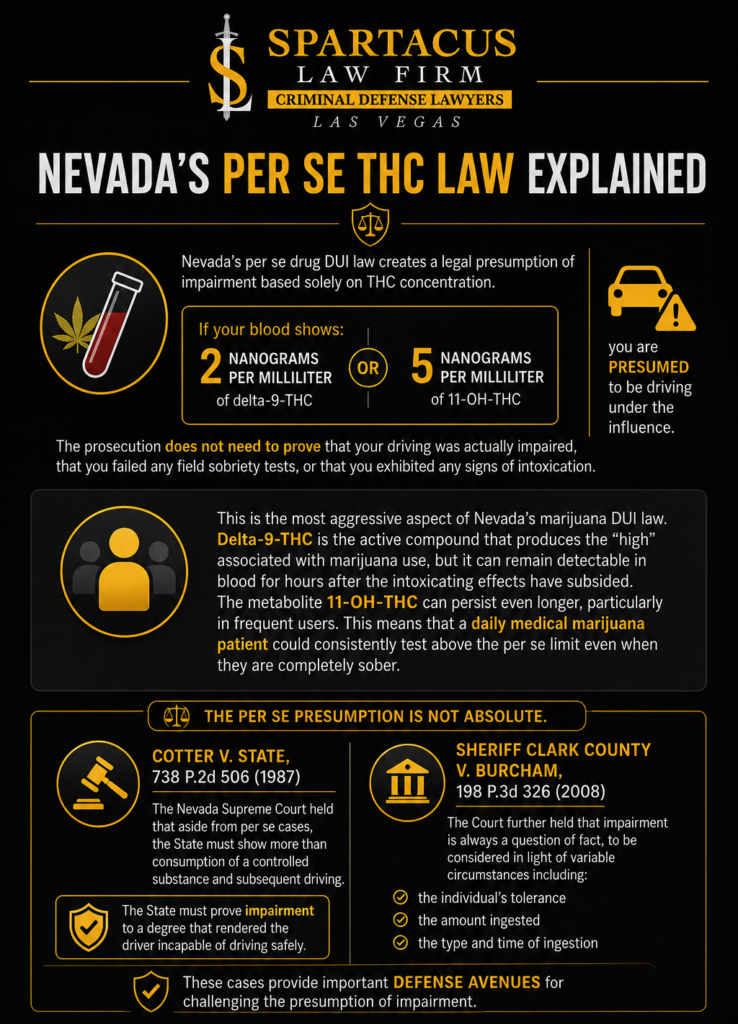
Nevada’s per se drug DUI law creates a legal presumption of impairment based solely on THC concentration. If your blood shows 2 nanograms per milliliter of delta-9-THC or 5 nanograms per milliliter of 11-OH-THC, you are presumed to be driving under the influence. The prosecution does not need to prove that your driving was actually impaired, that you failed any field sobriety tests, or that you exhibited any signs of intoxication.
This is the most aggressive aspect of Nevada’s marijuana DUI law. Delta-9-THC is the active compound that produces the “high” associated with marijuana use, but it can remain detectable in blood for hours after the intoxicating effects have subsided. The metabolite 11-OH-THC can persist even longer, particularly in frequent users. This means that a daily medical marijuana patient could consistently test above the per se limit even when they are completely sober.
However, the per se presumption is not absolute. Under Cotter v. State, 738 P.2d 506 (1987), the Nevada Supreme Court held that aside from per se cases, the State must show more than consumption of a controlled substance and subsequent driving. The State must prove impairment to a degree that rendered the driver incapable of driving safely. Under Sheriff Clark County v. Burcham, 198 P.3d 326 (2008), the Court further held that impairment is always a question of fact, to be considered in light of variable circumstances including the individual’s tolerance, the amount ingested, and the type and time of ingestion. These cases provide important defense avenues for challenging the presumption of impairment.
Medical Marijuana and Driving in Nevada
Having a valid Nevada medical marijuana card does not provide any protection against a marijuana DUI charge. Under NRS 484C.110, the per se limits apply equally to recreational and medical marijuana users. The law does not distinguish between a person who consumed marijuana recreationally and a patient who took a prescribed dose of medical marijuana for a qualifying condition.
Doctors in Nevada may also prescribe Marinol (synthetic THC), which will show up as marijuana or marijuana metabolite in a blood test. The Nevada Supreme Court has held that the distinction between prescribed medications and prescribed illicit substances is meaningful, because prescription drugs are approved by the FDA for specific potencies and dosages and come with warnings about driving. However, if the prosecution can prove that the prescribed substance impaired the driver’s ability to operate a vehicle safely, a conviction can still stand.
If you are a medical marijuana patient who drives regularly, the per se law creates significant ongoing legal exposure. Consulting with an experienced marijuana DUI attorney about your rights and risks is strongly recommended.
How to Defend Against a Marijuana DUI Charge
Several defense strategies can be effective in marijuana DUI cases, depending on the specific facts.
Challenging the Traffic Stop
If the officer lacked probable cause or reasonable articulable suspicion to initiate the traffic stop, all evidence obtained after the stop, including blood test results, can be suppressed through a motion to suppress. This is often the most effective defense when the evidence of impairment is otherwise strong.
Challenging the Blood Test
Blood tests are the prosecution’s primary evidence in a marijuana DUI case, but they are vulnerable to challenge. Defense arguments include contamination of the sample, improper storage causing degradation, expired collection tubes, failure to draw the blood within a reasonable timeframe, and issues with chain of custody. At Spartacus Law Firm, we analyze the testing equipment, certifications, and laboratory procedures to determine whether any contamination or procedural failure could have affected the results.
Challenging the Presumption of Impairment
Because marijuana stays in the system long after the intoxicating effects have worn off, proving actual impairment in a marijuana DUI case can be difficult for prosecutors. If the blood draw occurred hours after the stop, the THC levels at the time of driving may have been significantly different from the levels at the time of testing. An experienced defense attorney can present evidence of the driver’s behavior, speech, coordination, and driving pattern to rebut the presumption that they were impaired.
Challenging the Warrant for Blood Draw
If the driver did not consent to the blood draw, the officer must have obtained a valid warrant. If no warrant was obtained, or if the warrant was defective, the blood test results may be excluded from evidence. Following the U.S. Supreme Court’s decision in Missouri v. McNeely (2013), warrantless blood draws in DUI cases are presumptively unreasonable.
Will Your License Be Suspended After a Marijuana DUI?
Unlike an alcohol DUI where a breath test result is available at the scene, a marijuana DUI license suspension typically does not take effect until the blood test results are returned from the lab. This process can take weeks to months. Once the results come back positive, the Nevada DMV will notify the driver by mail that their license is being suspended. The driver may then request a DMV administrative hearing to contest the suspension.
Suspension periods for marijuana DUI convictions:
- First offense: 185-day suspension
- Second offense: 1-year suspension
- Third offense: 3-year suspension
Record Sealing for Marijuana DUI Convictions
Nevada does not allow expungement, but records can be sealed under NRS 179.245 and NRS 179.255:
- Misdemeanor marijuana DUI conviction: Eligible for sealing 7 years after case closure
- Marijuana DUI reduced to reckless or careless driving: Eligible for sealing 1 year after case closure
- Dismissed marijuana DUI charges: Eligible for sealing immediately
- Third-offense felony marijuana DUI: Cannot be sealed
For more information, visit our record sealing page.
Marijuana DUI and Professional License Consequences
A marijuana DUI arrest or conviction can trigger disciplinary proceedings for licensed professionals in Nevada. Nurses, doctors, pharmacists, dentists, and other healthcare professionals face particular scrutiny because any drug-related offense raises questions about fitness to practice and patient safety. A marijuana DUI charge can result in a separate investigation by your licensing board, even if the criminal case is ultimately resolved favorably.
Spartacus Law Firm defends professionals facing both criminal charges and licensing board complaints. For more information, see our pages on how nurses accused of substance abuse in Nevada face investigations, or our overview of professional license defense.

Las Vegas Marijuana DUI Lawyer Answers Your Frequently Asked Questions
Can you get a DUI for marijuana in Nevada?
Yes. Under NRS 484C.110, it is illegal to drive with 2 nanograms per milliliter of delta-9-THC or 5 nanograms per milliliter of marijuana metabolite in your blood. You can also be charged if marijuana impaired your ability to drive safely, regardless of your blood THC level.
Is a marijuana DUI a felony in Nevada?
A first or second marijuana DUI is charged as a misdemeanor. A third marijuana DUI within seven years is elevated to a Category B felony, carrying 1 to 6 years in prison and fines up to $5,000. A marijuana DUI that causes death or serious injury is also charged as a felony.
Will I go to jail for a first-time marijuana DUI?
While jail time is possible, most first-time marijuana DUI defendants receive time served for the initial arrest and booking period. The sentence is typically suspended in favor of probation, DUI school, and a Victim Impact Panel. If the marijuana DUI involved injury to another person, the likelihood of jail time increases.
How is THC level determined in a marijuana DUI case?
THC levels are determined through a blood draw. Unlike alcohol, marijuana cannot be detected by a breath test. After the blood is drawn by a qualified technician, the sample is sent to a laboratory for analysis. Results typically take several weeks to return.
Can I defend myself against a marijuana DUI charge?
Yes. Common defenses include challenging the probable cause for the traffic stop, challenging the accuracy or handling of the blood test, rebutting the presumption of impairment (since THC stays in the system long after the high wears off), and challenging whether a warrant was properly obtained for the blood draw. An experienced attorney can evaluate which defenses apply to your specific case.
Does a medical marijuana card protect me from a DUI?
No. Having a valid medical marijuana card provides no legal protection against a marijuana DUI charge in Nevada. The per se THC limits apply equally to recreational and medical users. If your blood exceeds the statutory threshold or if you are impaired while driving, you can be charged regardless of your medical authorization.
Will my license be suspended after a marijuana DUI?
Yes, unless the charge is dismissed or you prevail at a DMV administrative hearing. A first offense carries a 185-day suspension, a second offense carries a one-year suspension, and a third offense carries a three-year suspension. The suspension typically does not begin until blood test results confirm the presence of THC.
Can a marijuana DUI be reduced to a lesser charge?
Yes. Prosecutors may agree to reduce a marijuana DUI to reckless driving, careless driving, or speeding through plea negotiations, particularly when there are weaknesses in the evidence. A reduction to reckless driving shortens the record sealing waiting period from seven years to one year.
Can my marijuana DUI be sealed from my record?
A misdemeanor marijuana DUI conviction can be sealed seven years after the case is closed. If the charge was reduced to reckless or careless driving, it can be sealed after one year. Dismissed charges can be sealed immediately. Third-offense felony convictions cannot be sealed.
What should I do after being arrested for a marijuana DUI?
Do not discuss your case with anyone except your attorney. Do not consent to further questioning beyond basic identification. Write down everything you remember about the stop, arrest, and testing while it is fresh. If you received notice of a license suspension, you have a limited time to request a DMV hearing. Contact a qualified Las Vegas DUI attorney as soon as possible.
Contact Our Las Vegas Marijuana DUI Attorney Today
A marijuana DUI charge in Nevada can affect your driving privileges, your career, your professional licenses, and your criminal record for years. At Spartacus Law Firm, attorney Chandon S. Alexander fights marijuana DUI charges by challenging every element of the prosecution’s case, from the initial traffic stop to the blood test results to the presumption of impairment. Our firm has been recognized as a top-ranked DUI law firm, and we will fight to protect your rights and your future.
We have two office locations to serve you:
400 S 7th St, Suite 100, Las Vegas, NV 89101
3993 Howard Hughes Parkway, Suite 480, Las Vegas, NV 89169