
Las Vegas Peptide & Healthcare Regulatory Defense Lawyer
Related Practice Areas
Other Practice Areas
Defending the Practitioners Shaping Modern Medicine
Spartacus Law Firm represents physicians, pharmacists, nurses, clinic owners, and compounding operations facing investigation and discipline at the intersection of peptide therapy, pharmacy compounding, and the evolving federal and state regulatory framework.
If you have received a Board investigation letter, FDA Form 483 observation, or notice of accusation, the next ninety-six hours matter most. Every response you give, every document you produce, and every statement you make during the earliest stage of contact with an investigator shapes the outcome of your case. Spartacus Law Firm provides confidential, direct attorney access twenty-four hours a day, seven days a week.
Call (702) 660-1234 now for a confidential consultation.
A Defense Built for the Highly Regulated Professional
Attorney Chandon S. Alexander built Spartacus Law Firm to defend professionals whose careers and livelihoods sit inside the most aggressively policed corners of American medicine. Few areas have moved faster, or more punitively, than peptide therapy, GLP-1 compounding, and the regulation of pharmacies, prescribers, and clinics operating in those spaces.
Our representation is designed for the practitioner: the physician explaining hormone optimization protocols to a board investigator, the compounding pharmacist responding to a Form 483, the nurse practitioner answering for a single charting entry, the medical spa owner whose website caught the eye of a federal regulator. Whatever the entry point, the goal is consistent. Protect the license, protect the practice, and resolve the matter before it ever reaches the public docket.
We represent clients in Nevada and on a case-selected basis nationally, defending them from the first investigator phone call through administrative hearing, federal grand jury, and, where necessary, appeal.
What We Defend
- Peptide, GLP-1, and compounded-drug enforcement matters at both the federal and state level
- Pharmacy board complaints, 503A inspections, and PBM-driven audits
- Medical Board and Nursing Board accusations, from investigation through hearing
- DEA registration actions, FDA warning letters, and parallel criminal exposure
Peptide and Compounding Defense
A regulatory frontier that changes by the month
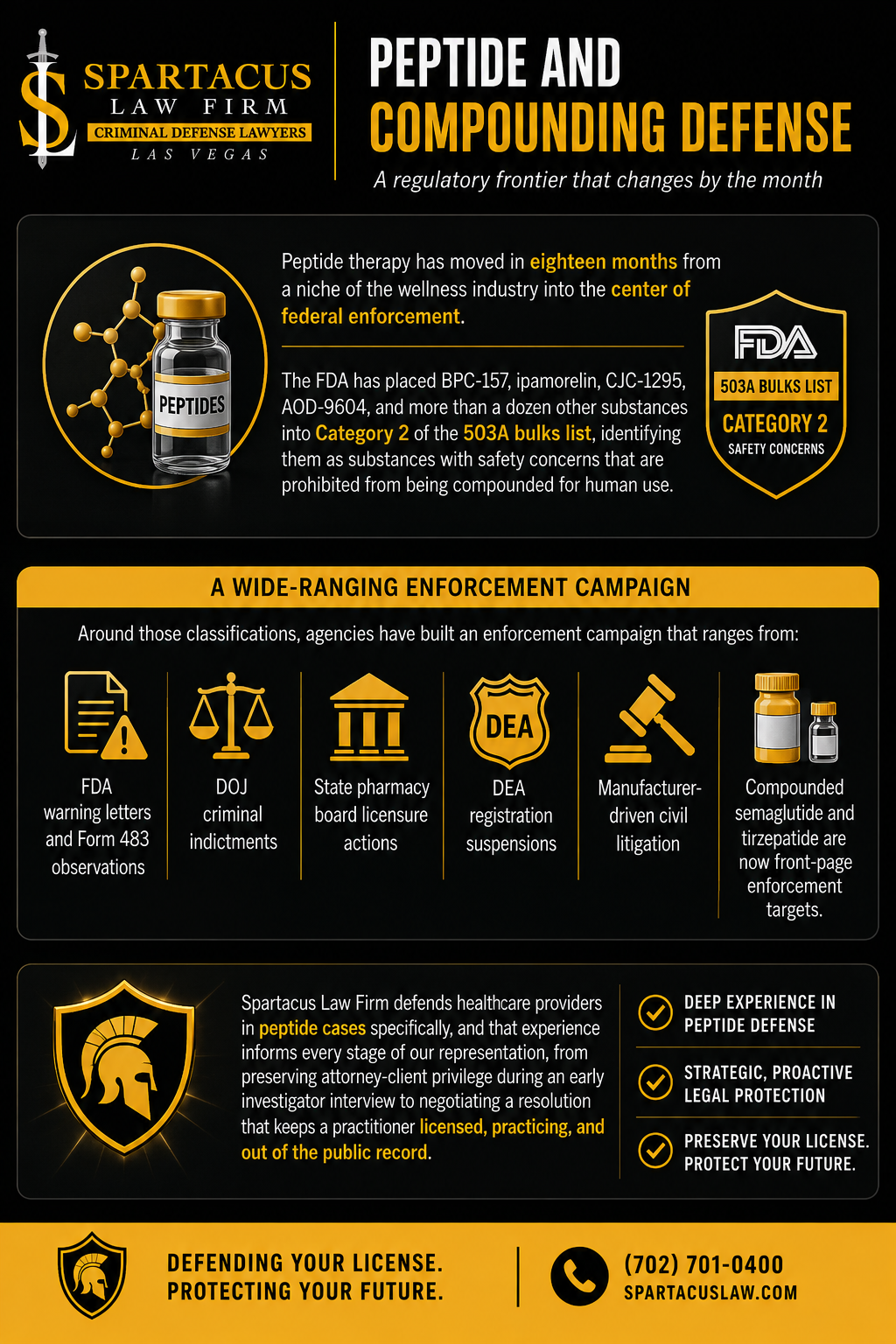
Peptide therapy has moved in eighteen months from a niche of the wellness industry into the center of federal enforcement. The FDA has placed BPC-157, ipamorelin, CJC-1295, AOD-9604, and more than a dozen other substances into Category 2 of the 503A bulks list, identifying them as substances with safety concerns that are prohibited from being compounded for human use.
Around those classifications, agencies have built an enforcement campaign that ranges from FDA warning letters and Form 483 observations to DOJ criminal indictments, state pharmacy board licensure actions, DEA registration suspensions, and manufacturer-driven civil litigation by companies including Novo Nordisk and Eli Lilly. Compounded semaglutide and tirzepatide, once protected by the shortage exception, are now front-page enforcement targets.
Spartacus Law Firm defends healthcare providers in peptide cases specifically, and that experience informs every stage of our representation, from preserving attorney-client privilege during an early investigator interview to negotiating a resolution that keeps a practitioner licensed, practicing, and out of the public record.
503A and 503B Compounding Framework
We advise and defend pharmacies and prescribers operating under Sections 503A and 503B of the Federal Food, Drug, and Cosmetic Act. This includes matters involving the bulk substance list, USP monograph requirements, the FDA shortage exception, API sourcing and certificate-of-analysis review, and the line between traditional compounding and unauthorized manufacture.
GLP-1 and Peptide Enforcement
We defend compounders and clinicians involved with semaglutide, tirzepatide, BPC-157, ipamorelin, CJC-1295, MK-677, AOD-9604, NAD+, sermorelin, and related substances. This includes manufacturer litigation, FDA warning letters, ITC exclusion orders, and the criminal exposure that flows from compounding a Category 2 substance for human use.
Research Use Only and Marketing Risk
We defend clinics and online vendors targeted for marketing peptides labeled “research use only” for therapeutic claims, and for bundling peptides with syringes, diluent, or dosing instructions in ways the FDA construes as intent for human use. Marketing audits and intake-form review are part of every engagement.
Parallel Criminal and Civil Exposure
Federal peptide investigations rarely stay regulatory. They escalate into prosecutions under the FDCA, healthcare fraud, wire fraud, money laundering, and conspiracy statutes. As a criminal defense firm at our core, we represent clients in both forums simultaneously and protect the licensure record from collateral fallout.
What We Defend Against
- FDA Warning Letters
- FDA Form 483 Observations
- FDA Facility Inspections and Raids
- DEA Registration Actions
- Nevada Board of Pharmacy Complaints
- Out-of-State Board of Pharmacy Discipline
- Manufacturer-Driven Civil Litigation
- DOJ Criminal Investigations and Indictments
- PBM Audits and Network Sanctions
- State Attorney General Actions
- OIG and HHS Investigations
- Payment Processor and Banking Disruption
Licensure Defense
Medical Board, Nursing Board, and every accusation in between
For most healthcare professionals, the threat to a license is the threat to a career. We represent providers facing accusations, investigations, and discipline before state licensing authorities, and we are engaged at every phase, from the first investigator call to the contested administrative hearing and, where necessary, judicial review.
A board investigation does not look like a criminal case, and it should not be defended like one. The procedural rules are different, the standard of proof is different, the prosecutor reports to a different agency, and the consequences attach in a way a criminal court can never undo. Public discipline visible on a national database, mandatory cost recovery, probationary conditions, suspension, and revocation follow a practitioner from state to state for the rest of their working life.
Our representation centers on three goals: resolve the matter quietly when it can be resolved, contest the matter forcefully when it cannot, and protect the licensure record from the kind of collateral damage that follows a practitioner across jurisdictions permanently.
We defend physicians, advanced practice providers, nurses, pharmacists, dentists, psychologists, and other regulated professionals, and we coordinate licensure defense with any parallel criminal, civil, or federal regulatory matter the same client may be facing.
Medical Board Accusations
Physicians and Physician Assistants
Standard-of-care allegations, prescribing investigations, off-label use, peptide protocols, and Compact-related discipline. We handle Notice of Defense filings, OAH hearings, settlement negotiations, and writ review. If you are a doctor facing license defense issues, our firm understands the specific procedural landscape of medical board proceedings.
Nursing Board Accusations
RNs, APRNs, and LPNs
Practice-act violations, scope-of-practice disputes, peptide and IV-therapy administration, charting allegations, diversion allegations, and substance-use complaints. Nurse license defense requires an attorney who understands the differences between Board of Nursing proceedings and criminal court.
Pharmacy Board Discipline
RPh and PharmD
Compounding violations, 503A operational scrutiny, recordkeeping and storage findings, dispensing pattern audits, and parallel DEA registration matters. Our pharmacist license defense practice is built to handle the overlap between state board discipline and federal regulatory exposure.
Dental Board Defense
DDS and DMD
Anesthesia and sedation allegations, standard-of-care complaints, controlled substance prescribing, and recordkeeping discipline. Our dentist license defense attorneys understand the specific procedural requirements that apply to dental board proceedings in Nevada and nationally.
Mental Health Board Defense
Psychologists and Therapists
Boundary allegations, dual-relationship complaints, recordkeeping issues, and supervisory standards before Nevada and out-of-state boards. Our psychologist license defense practice addresses the unique evidentiary and procedural issues these cases present.
Reciprocal and Cross-State Discipline
Multi-State and Compact Matters
Defense against reciprocal action where discipline in one state triggers an automatic proceeding in another. This includes Nurse Licensure Compact and Interstate Medical Licensure Compact matters. A single adverse outcome can cascade across every state where a provider holds a license.

The Process: From the First Letter to the Final Order
Healthcare disciplinary matters move along a defined path, and the strategy at each step is different. We are engaged from the earliest point our clients allow, and our experience is that the work done in the investigation phase often determines whether the matter ever reaches a hearing at all.
Phase 1: Initial Investigation
The complaint arrives. An investigator calls, an inspector visits, a Form 483 issues, or a subpoena lands. We intervene immediately to control the flow of information, prepare any responses, and shape the factual record before it hardens.
Phase 2: Pre-Accusation Resolution
Most board matters never have to reach a formal accusation. We work to resolve the matter at the investigative stage through written responses, expert review, mitigation packets, and direct negotiation with the deputy attorney general or board counsel.
Phase 3: Accusation and Notice of Defense
When the agency files a formal accusation, the response window is short, often fifteen days. We file the Notice of Defense, raise affirmative defenses, request discovery, and begin building toward either a stipulated settlement or a contested administrative hearing.
Phase 4: Administrative Hearing and Beyond
The hearing is presented before an Administrative Law Judge with witnesses, exhibits, and cross-examination. Our team prepares the case for hearing, presents it, and, should the result require it, pursues board review, writ of mandate, and reinstatement petitions.
Who We Represent
Practitioners and operators across the regulated healthcare economy.
The peptide and compounded-drug economy touches an unusually wide range of practitioners. We represent each of them, and our clients value that the firm understands the regulatory landscape from both the prescriber’s chair and the pharmacy bench.
Physicians and Prescribers
MDs, DOs, PAs, and NPs prescribing peptide therapy, hormone optimization, and compounded GLP-1s, including telehealth-only practices.
Compounding Pharmacies
503A and 503B pharmacies and pharmacists facing FDA inspections, state board investigations, and DEA registration matters.
Nurses and Advanced Practice Providers
RNs, APRNs, CRNAs, and IV-therapy practitioners facing Board of Nursing complaints, including scope-of-practice and administration issues.
Med Spas and Wellness Clinics
Operators of peptide, hormone, IV, and weight-loss clinics facing state investigation, FDA scrutiny, or marketing-driven enforcement.
Telehealth Platforms
Telehealth companies prescribing compounded peptides and GLP-1s across state lines and facing multi-jurisdictional regulatory exposure.
Online Vendors and Suppliers
Companies selling peptides labeled “research use only” who have become the target of FDA, FTC, or state attorney general enforcement.
A Criminal Defense Firm at the Regulatory Frontier
The dividing line that used to separate regulatory cases from criminal cases has effectively collapsed in the peptide and compounded-drug space. A pharmacy board investigation can become a federal grand jury subpoena. A patient complaint can become a parallel DOJ matter. An FDA warning letter can become the foundation of a state attorney general action.
That convergence is why Spartacus Law Firm built its healthcare regulatory practice on a criminal defense foundation. We treat every regulatory file as a case that could one day become an indictment, and we preserve every defense, every privilege, every motion, and every record accordingly.
Our clients receive direct attorney access from intake through resolution. We do not delegate intake to staff, we do not warehouse files, and we do not negotiate from a place of inexperience. Attorney Chandon S. Alexander personally evaluates every healthcare regulatory matter the firm accepts.
“The professional who calls us is rarely the bad actor the agency assumes. They are a clinician, a pharmacist, an operator, making careful decisions in a landscape the regulators themselves cannot agree on. Our work is to translate that complexity into a record the agency cannot ignore.”
– Chandon S. Alexander, Esq. | Founder, Spartacus Law Firm
Frequently Asked Questions About Peptide and Healthcare Regulatory Defense
What should I do if I receive an FDA Warning Letter or Form 483?
Do not respond before consulting an attorney. An FDA Warning Letter or Form 483 observation is a formal agency action that requires a carefully crafted response within a specific timeframe, typically fifteen business days for a Warning Letter. Your response becomes part of the permanent regulatory record. Spartacus Law Firm reviews the findings, assesses your exposure, and drafts a response designed to resolve the matter without escalation to enforcement action.
Can I still compound peptides like BPC-157 or semaglutide?
The regulatory landscape around compounded peptides is changing rapidly. The FDA has placed BPC-157, ipamorelin, CJC-1295, AOD-9604, and other substances on the Category 2 list, effectively prohibiting their compounding for human use under Section 503A. Compounded semaglutide and tirzepatide were previously protected under the shortage exception, but that protection has largely expired. If you are currently compounding any of these substances, legal counsel should evaluate your exposure immediately.
What is the difference between a 503A and 503B pharmacy?
A 503A pharmacy compounds medications based on individual patient prescriptions under state pharmacy board oversight. A 503B outsourcing facility compounds without individual prescriptions and is registered with and inspected by the FDA. The regulatory obligations, inspection standards, and enforcement risks differ significantly between the two. Many of the current peptide enforcement actions target pharmacies that are operating under 503A but whose practices the FDA characterizes as manufacturing, which falls under 503B requirements.
Can I lose my medical license for prescribing peptides?
Yes. State medical boards can and do investigate physicians for prescribing peptides, particularly when the prescribing involves substances the FDA has classified as unsafe for compounding, when the prescribing occurs through telehealth without adequate patient evaluation, or when the board receives a patient complaint. An investigation can result in a public letter of reprimand, probation with practice restrictions, suspension, or revocation. Our professional license defense practice is built to intervene at the earliest stage possible.
What is the criminal exposure for peptide violations?
Federal peptide investigations can result in charges under multiple statutes, including violations of the Federal Food, Drug, and Cosmetic Act, healthcare fraud (18 U.S.C. 1347), wire fraud (18 U.S.C. 1343), money laundering, and conspiracy. Penalties can include substantial prison time, forfeiture, and permanent exclusion from federal healthcare programs. Because Spartacus Law Firm is a criminal defense firm at its core, we handle both the regulatory and criminal tracks simultaneously.
Will my board investigation become a criminal case?
Not always, but the risk is real and growing. In the peptide and compounding space, parallel proceedings are increasingly common. A state pharmacy board investigation can trigger a referral to the DEA or DOJ. A patient complaint filed with the medical board can lead to a parallel criminal investigation. We treat every regulatory file as a potential criminal matter from day one and preserve every defense accordingly.
Do you handle cases outside of Nevada?
Yes. While our offices are in Las Vegas, we accept healthcare regulatory and peptide defense matters on a case-selected basis nationally. Federal enforcement actions, FDA matters, and DEA registration issues are federal in nature and do not depend on the state where the provider is located. For state-level board matters outside Nevada, we coordinate with local counsel as needed while maintaining strategic oversight of the case.
What should I do if an investigator contacts me?
Do not provide a statement, produce documents, or consent to an inspection without first consulting an attorney. You have the right to legal representation during any investigative contact. What you say during the first phone call or site visit often becomes the foundation of the agency’s case. Call Spartacus Law Firm at (702) 660-1234 before you respond.
How long do healthcare board investigations take?
Timelines vary significantly by agency and case complexity. A straightforward Board of Nursing complaint in Nevada may resolve in three to six months. A complex pharmacy board matter involving parallel federal exposure can extend beyond a year. FDA enforcement timelines depend on the agency’s priorities and caseload. Our goal in every case is to resolve the matter at the earliest possible stage, ideally before a formal accusation is ever filed.
What does it cost to hire a healthcare regulatory defense attorney?
Every case is different. Spartacus Law Firm offers a confidential initial consultation to evaluate your situation, assess your exposure, and provide a clear understanding of what representation will involve. We do not publish fee schedules, but we are transparent about costs from the first conversation. Call (702) 660-1234 to schedule your consultation.
Schedule a Confidential Consultation
If your license, pharmacy, or clinic is under scrutiny, call before you respond
Every healthcare regulatory matter starts with one decision: what to say, what to produce, and what to withhold during the earliest contact with the agency. That decision is rarely reversible. Spartacus Law Firm is available twenty-four hours a day to help you make it correctly.
Downtown Office
400 S 7th Street, Suite 100
Las Vegas, NV 89101
Howard Hughes Office
3993 Howard Hughes Parkway, Suite 480
Las Vegas, NV 89169
Direct: (702) 660-1234
spartacuslawfirm.com | Open 24 hours, 7 days
Contact Spartacus Law Firm to schedule your confidential consultation today.