


On June 29, 2026, the FDA’s career scientists posted briefing documents for the upcoming Pharmacy Compounding Advisory Committee (PCAC) meeting scheduled for July 23 and 24. In each document, the agency recommended against easing restrictions on the peptides under review, concluding there was not enough evidence of safety or effectiveness to allow broader compounding access.
For healthcare providers, pharmacists, and clinic operators who prescribe, compound, or sell peptides, this is not background noise. It is a direct signal from the agency that enforcement is not slowing down, and the regulatory gray area many practices have been operating in is narrowing by the week.
This article breaks down what is happening at the FDA, which substances are under review, what the briefing documents actually say, and what the legal exposure looks like for providers and pharmacies right now.
What Is the PCAC Meeting and Why Does It Matter?
The Pharmacy Compounding Advisory Committee is the FDA body responsible for evaluating whether specific bulk drug substances should be added to the 503A Bulks List. That list determines which substances compounding pharmacies can legally use to prepare medications under Section 503A of the Federal Food, Drug, and Cosmetic Act.
None of the seven peptides scheduled for review at the July meeting have a USP or NF monograph. None of them are components of an FDA-approved drug product. That means the only pathway for a 503A pharmacy to legally compound them on a routine basis is for the FDA to add them to the 503A Bulks List, or for the agency to announce specific enforcement discretion.
The PCAC’s recommendations are non-binding. The FDA is not legally required to follow them. But the committee’s vote carries significant weight, and the briefing documents the FDA posted ahead of the meeting reveal where the agency’s career scientists stand on each substance.
The 7 Peptides Under Review
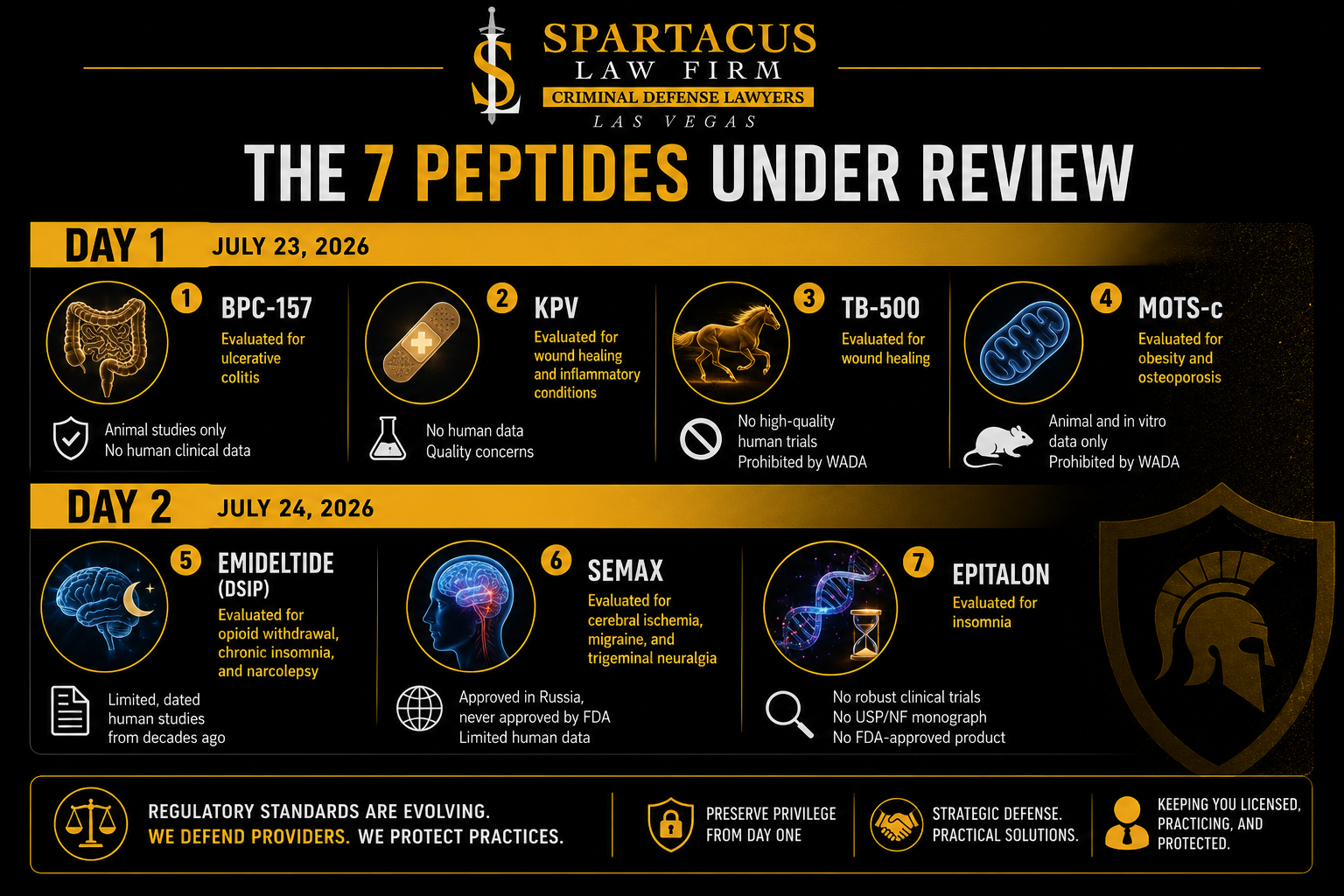
The PCAC will review seven peptides across two days. Understanding which substances are on the table, and what the FDA evaluated each one for, is essential for any provider whose practice touches these compounds.
Day 1: July 23, 2026
- BPC-157 (Body Protection Compound). Evaluated for ulcerative colitis. BPC-157 is the most widely known peptide in the wellness and longevity space. Clinics and online vendors promote it for gut healing, tendon repair, and systemic anti-inflammatory effects. The FDA briefing documents note inconsistent naming conventions, the absence of an established US Adopted Name, a near-total reliance on animal studies, and a lack of human clinical trial data meeting contemporary evidentiary standards.
- KPV (lysine-proline-valine tripeptide). Evaluated for wound healing and inflammatory conditions. KPV is a fragment of alpha-melanocyte stimulating hormone. The FDA found no substantial published information on its use in humans for wound healing or inflammatory conditions. The agency flagged concerns about product quality, including the absence of impurity profiles and microbiological testing in publicly available literature.
- TB-500 (thymosin beta-4 analogue). Evaluated for wound healing. TB-500 has deep roots in the performance enhancement world, where it has been used in equine and greyhound racing. It is currently prohibited by WADA. The FDA found no high-quality human clinical trials evaluating TB-500 for wound healing.
- MOTS-c (mitochondrial-derived peptide). Evaluated for obesity and osteoporosis. Marketed in the longevity space as a metabolic regulator. The FDA found the efficacy data largely confined to animal and in vitro models, with no substantial information on human use for either indication. MOTS-c is also classified as a prohibited substance by WADA.
Day 2: July 24, 2026
- Emideltide (also known as DSIP, delta sleep-inducing peptide). Evaluated for opioid withdrawal, chronic insomnia, and narcolepsy. The FDA found the clinical evidence limited and dated, consisting of small human studies conducted decades ago with mixed results. The inclusion of opioid withdrawal as an evaluated indication signals the FDA’s concern about unproven interventions being promoted for complex, high-risk conditions.
- Semax (ACTH-derived heptapeptide). Evaluated for cerebral ischemia, migraine, and trigeminal neuralgia. Semax has been approved in Russia for certain neurological indications but has never been approved by the FDA. The agency noted that the human data supporting its use was generated under a regulatory framework that differs from FDA standards, with limited sample sizes and sparse reporting in English-language literature.
- Epitalon (synthetic tetrapeptide). Evaluated for insomnia. Marketed aggressively in the anti-aging space with claims about telomere lengthening and lifespan extension. The FDA narrowed its review to insomnia and found no robust, modern clinical trials supporting the indication. The agency noted the absence of any USP or NF monograph, no FDA-approved product containing Epitalon, and no widely accepted quality control standard.
What the FDA Briefing Documents Actually Say
Across all seven peptides, the FDA’s briefing documents raise three recurring concerns that providers and pharmacists should pay close attention to.
Insufficient Evidence of Safety and Effectiveness
For every substance under review, the FDA concluded that the available evidence does not meet the standard required for inclusion on the 503A Bulks List. The human data is either absent, decades old, limited to small exploratory studies, or generated under non-FDA regulatory frameworks. The gap between what is being marketed to patients and what the clinical evidence actually supports is, in the FDA’s assessment, substantial.
Chemical Characterization and Quality Control Gaps
The FDA flagged serious quality concerns across the board. These include inconsistent naming conventions, the absence of standardized impurity profiles, missing endotoxin testing, and a lack of Certificates of Analysis from pharmaceutical-grade suppliers. For injectable peptides, these quality gaps are not technical footnotes. They translate directly into patient safety risks, including the potential for contamination, degradation, and unpredictable immunogenic responses.
Immunogenicity Risks
Several of the peptides under review fall into a size range where they can act as antigens when injected, potentially triggering immune responses. The FDA noted that this risk is amplified when manufacturing controls on aggregation and impurities are weak, which is precisely the situation with many commercially available peptide products sourced from non-pharmaceutical-grade suppliers.
Removal from Category 2 Does Not Mean Compounding Is Legal
One of the most dangerous misconceptions circulating in the peptide space right now is that the FDA’s April 2026 removal of twelve peptides from the Category 2 “do not compound” list means those substances are now legal to compound. That is not what happened.
The FDA removed certain peptides from Category 2 to clear the way for the advisory committee review process. It did not move them to Category 1, which is the designation that would signal enforcement discretion for compounding. It did not add them to the 503A Bulks List. And it did not issue any guidance stating that compounding these substances is permissible during the pendency of the review.
Multiple healthcare law firms have emphasized this point publicly: removal from Category 2 is not a green light. Pharmacies and providers who treat it as one are operating in a legally and regulatorily uncertain space, and they are doing so at a time when federal enforcement of peptide-related violations is at an all-time high.
The Enforcement Landscape: Warning Letters, Raids, and Criminal Charges
The FDA’s briefing documents do not exist in a vacuum. They arrive against the backdrop of the most aggressive enforcement campaign the peptide industry has ever seen.
50+ FDA Warning Letters to Compounders
In September 2025, the FDA issued more than 50 warning letters to companies that compound or manufacture GLP-1 products, including compounded semaglutide and tirzepatide. The warnings targeted false and misleading marketing claims, including statements that compounded products are “generic versions” or contain the “same active ingredient” as FDA-approved drugs.
Warehouse Raids and Vendor Shutdowns
FDA enforcement has escalated from warning letters to physical raids. In June 2025, the FDA raided the warehouse of Amino Asylum, one of the largest research peptide vendors in the country. The company’s founders pleaded guilty to federal charges in December 2025. In March 2026, Peptide Sciences voluntarily shut down its entire operation. At least eight major peptide vendors closed between mid-2025 and early 2026.
Criminal Prosecutions and Forfeitures
Tailor Made Compounding was prosecuted by the Department of Justice for distributing unapproved peptides, including BPC-157, and was forced to forfeit $1.79 million. This case established that the federal government is willing to pursue criminal charges, not just civil penalties, against peptide businesses. For healthcare providers connected to these supply chains, the exposure extends beyond the pharmacy counter. Prescribers, clinic operators, and even marketing personnel can face parallel investigations.
If you are a provider or pharmacy operator who has received an FDA Warning Letter, Form 483 observation, or any contact from a federal investigator, the decisions you make in the first 96 hours will shape the outcome of your case. Spartacus Law Firm’s peptide and healthcare regulatory defense practice is built specifically for these matters.
What This Means for Compounding Pharmacies
For 503A compounding pharmacies, the July PCAC meeting creates a decision point. The FDA’s briefing documents signal that the agency is unlikely to recommend adding these seven peptides to the 503A Bulks List at this time. Even if the PCAC were to vote favorably on one or more substances, formal rulemaking to actually add them to the list typically takes twelve to twenty-four months.
That means pharmacies currently compounding any of these peptides face continued legal uncertainty for the foreseeable future. The key risks include FDA inspection and Form 483 findings, state Board of Pharmacy complaints and disciplinary action, DEA registration challenges if controlled substance overlaps exist, and potential DOJ referral for products the FDA considers unapproved new drugs.
Pharmacists facing board complaints or disciplinary proceedings related to compounding practices should consult with a pharmacist license defense attorney who understands the intersection of federal compounding law and state pharmacy board procedures.
What This Means for Prescribers and Clinic Operators
Physicians, nurse practitioners, PAs, and clinic operators face a different but equally serious set of risks. State medical boards and nursing boards can and do investigate providers for prescribing peptides, particularly when the prescribing involves substances the FDA has flagged as unsafe for compounding, when prescriptions are written through telehealth platforms without adequate patient evaluation, or when the board receives a patient complaint.
A board investigation can result in a public letter of reprimand, probation with practice restrictions, suspension, or full revocation of a medical license. For physicians, this means a permanent mark on the National Practitioner Data Bank. For nurse practitioners and PAs, it means potential reciprocal discipline in every state where they hold a license.
The risk is not limited to providers who are doing anything wrong. A single patient complaint, a marketing claim that catches a regulator’s attention, or a supply chain connection to a vendor under federal investigation can trigger a proceeding that puts a provider’s entire career at stake.
Spartacus Law Firm defends physicians, nurses and nurse practitioners, and other healthcare providers facing board investigations and accusations. Our professional license defense practice is designed to intervene at the earliest stage, ideally before a formal accusation is ever filed.
The Political Dimension: RFK Jr., the FDA, and What Comes Next
The July PCAC meeting has taken on additional significance because of the political tension between Health and Human Services Secretary Robert F. Kennedy Jr. and the FDA’s career scientists. In February 2026, Kennedy announced that roughly fourteen of the nineteen Category 2 peptides would be moved back to allow compounding access. The FDA’s April 2026 removal of twelve peptides from Category 2 appeared to align with that directive.
But the briefing documents posted on June 29 tell a different story. In every instance, the FDA’s career scientists recommended against easing restrictions, determining that the evidence did not support broader availability. The Washington Post reported on the disconnect, noting that the FDA staff recommendation “undercuts RFK Jr.’s push to expand peptides.”
For providers and pharmacists, the political back-and-forth is not academic. It creates real operational confusion. A provider reading RFK’s February announcement might reasonably conclude that compounding access is expanding. A provider reading the FDA’s June briefing documents would reach the opposite conclusion. And a provider who guessed wrong about which signal to follow could find themselves on the receiving end of an enforcement action.
The safest posture for any healthcare provider or pharmacy right now is to treat these substances as legally uncertain and to consult with legal counsel before making prescribing, compounding, or marketing decisions based on political announcements rather than finalized regulatory actions.
The “Research Use Only” Problem
A significant portion of the peptide market involves products labeled “for research use only” or “not for human consumption.” That label does not provide the legal protection many vendors and providers assume it does.
The FDA’s position is clear: if a product is being sold with syringes, diluent, dosing instructions, or is marketed alongside telemedicine consultations, the agency will treat it as intended for human use regardless of what the label says. Clinics and online vendors who bundle research-labeled peptides with injection supplies or who make therapeutic claims on their websites have become primary enforcement targets.
For clinic operators and online vendors, this means that every element of your marketing, packaging, and intake process is potential evidence. A marketing audit and intake-form review should be part of any compliance assessment, and it should be conducted with the guidance of an attorney who understands how the FDA construes intent.

How to Protect Your Practice Right Now
Whether the PCAC votes favorably or unfavorably on these seven peptides, the enforcement landscape is not going to soften in the near term. Formal rulemaking takes time. State board investigations operate independently of the federal process. And the DOJ has already demonstrated its willingness to pursue criminal charges.
If your practice touches peptide therapy, compounded GLP-1s, or any of the seven substances under PCAC review, there are steps you should be taking now.
Audit Your Supply Chain
Confirm that every bulk drug substance in your inventory is sourced from an FDA-registered facility with a valid Certificate of Analysis. If you are sourcing from vendors who have been shut down, raided, or have received warning letters, that supply chain connection is discoverable by investigators.
Review Your Marketing
Remove or revise any website content, social media posts, or intake materials that make therapeutic claims about peptides the FDA has not approved. This includes claims about BPC-157 for tissue repair, MOTS-c for weight loss, Epitalon for anti-aging, and semaglutide or tirzepatide compounded products described as equivalent to branded drugs.
Prepare an Investigator Response Protocol
If a board investigator, FDA inspector, or federal agent contacts you, do not provide a statement, produce documents, or consent to an inspection before consulting with an attorney. What you say during the first phone call or site visit often becomes the foundation of the agency’s case.
Consult with Legal Counsel
The regulatory landscape is changing fast enough that compliance advice from six months ago may already be outdated. If you have questions about whether your current peptide prescribing, compounding, or marketing practices create exposure, contact Spartacus Law Firm for a confidential consultation. We are available 24/7 at (702) 660-1234.
Spartacus Law Firm Defends Healthcare Providers Facing Peptide and Regulatory Enforcement
Spartacus Law Firm represents physicians, pharmacists, nurses, clinic owners, telehealth operators, and compounding pharmacies facing investigation and discipline at the intersection of peptide therapy, pharmacy compounding, and federal and state regulatory enforcement.
Attorney Chandon S. Alexander personally evaluates every healthcare regulatory matter the firm accepts. We provide direct attorney access from intake through resolution, and we handle regulatory defense and criminal defense simultaneously when parallel proceedings arise.
If your license, pharmacy, or clinic is under scrutiny, call before you respond.
Downtown Office | 400 S 7th Street, Suite 100, Las Vegas, NV 89101
Howard Hughes Office | 3993 Howard Hughes Parkway, Suite 480, Las Vegas, NV 89169
Direct: (702) 660-1234 | Open 24 hours, 7 days