
Telehealth Prescribing Defense Lawyer
License Board Resources
Contact Us
Trusted Telehealth Prescribing Defense Lawyer in Las Vegas
The growth of telehealth has transformed how patients access medical care across Nevada and nationwide. But that growth has also drawn intense scrutiny from the Drug Enforcement Administration, the Department of Justice, and state medical boards. If you are a prescriber under investigation for telehealth prescribing practices, you face potential criminal prosecution, loss of your DEA registration, and disciplinary action that could end your career.
Spartacus Law Firm provides targeted legal defense for physicians, nurse practitioners, physician assistants, and pharmacists in Las Vegas and throughout Nevada who are under investigation or facing charges related to telehealth prescribing. Our team understands both the clinical realities of telemedicine practice and the regulatory framework that governs controlled substance prescribing, and we use that knowledge to build aggressive defense strategies that protect your license, your freedom, and your livelihood.
If a federal agent has contacted you, if you have received a DEA order to show cause, or if a state board has opened an investigation into your prescribing patterns, call (702) 660-1234 now. Early intervention can change the outcome of your case.
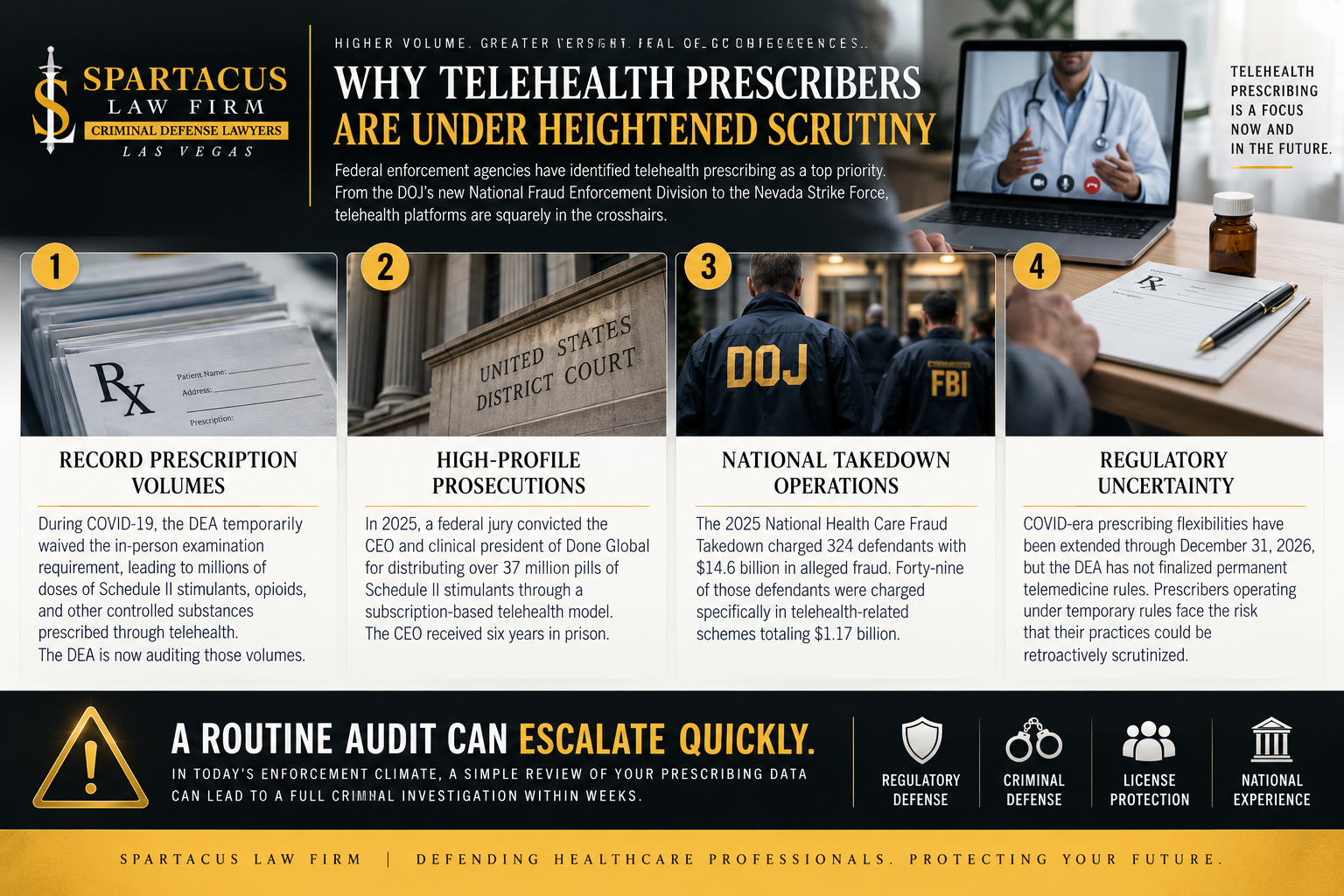
Why Telehealth Prescribers Are Under Heightened Scrutiny
Federal enforcement agencies have publicly identified telehealth prescribing as a top enforcement priority. The DOJ’s newly established National Fraud Enforcement Division, created in April 2026, has made healthcare fraud prosecutions a central focus. A West Coast Strike Force covering the District of Nevada specifically targets healthcare fraud schemes, including those tied to telehealth platforms.
Several factors are driving this enforcement surge:
- Record prescription volumes. During the COVID-19 public health emergency, the DEA temporarily waived the in-person examination requirement for controlled substances. Telehealth platforms prescribed millions of doses of Schedule II stimulants, opioids, and other controlled substances. The DEA is now auditing those volumes.
- High-profile prosecutions. In 2025, a federal jury convicted the CEO and clinical president of Done Global for distributing over 37 million pills of Schedule II stimulants through a subscription-based telehealth model. The CEO received six years in prison. The DOJ called it the first criminal drug distribution prosecution arising from telemedicine prescribing practices.
- National takedown operations. The 2025 National Health Care Fraud Takedown charged 324 defendants with $14.6 billion in alleged fraud. Forty-nine of those defendants were charged specifically in telehealth-related schemes totaling $1.17 billion.
- Regulatory uncertainty. COVID-era prescribing flexibilities have been extended through December 31, 2026, but the DEA has not finalized permanent telemedicine rules. Prescribers operating under temporary rules face the risk that their practices could be retroactively scrutinized.
In this enforcement climate, a routine audit of your prescribing data can escalate into a full criminal investigation within weeks. That is why having experienced criminal defense counsel on your side from the earliest stage is critical.
The Ryan Haight Act and Federal Telehealth Prescribing Law
The legal framework governing telehealth prescribing of controlled substances begins with the Ryan Haight Online Pharmacy Consumer Protection Act of 2008 (codified at 21 U.S.C. Section 829(e)). The Act prohibits any practitioner from prescribing a Schedule II through Schedule V controlled substance via the Internet unless the practitioner has conducted at least one prior in-person medical evaluation of the patient.
Under 21 CFR 1300.04, an “in-person medical evaluation” requires the patient to be in the physical presence of the practitioner. A single in-person visit alone does not satisfy the requirement; the prescription must also be issued for a legitimate medical purpose in the usual course of professional practice.
The Seven Telemedicine Exceptions
The Ryan Haight Act carved out seven specific exceptions allowing prescribing without an in-person visit:
- Treatment in a DEA-registered hospital or clinic where the patient is physically located
- Treatment while the patient is in the physical presence of another DEA-registered practitioner
- Indian Health Service employees or contractors acting within their scope
- During a public health emergency declared by the HHS Secretary (the basis for COVID-era flexibilities)
- Practitioners holding a DEA special telemedicine registration (never implemented until 2025 rulemaking)
- VA practitioners in a genuine medical emergency (limited to a 5-day supply)
- Other circumstances specified by joint DEA/HHS regulation
If your prescribing does not fall within one of these exceptions, each prescription issued without a prior in-person evaluation could be charged as a violation of 21 U.S.C. Section 841.
Penalties for Ryan Haight Act Violations
Violations are prosecuted under the federal Controlled Substances Act. The penalty structure is severe:
- Schedule II substances (Adderall, oxycodone, fentanyl): Up to 20 years imprisonment and fines up to $250,000 for individuals. If death or serious bodily injury results, 20 years to life.
- Schedule III substances (testosterone, buprenorphine, ketamine): Up to 10 years imprisonment and fines up to $500,000.
- Schedule IV substances (benzodiazepines, tramadol): Up to 5 years imprisonment and fines up to $250,000.
- For second or subsequent offenses, all maximum sentences and fines are doubled.
Beyond criminal penalties, practitioners face DEA registration revocation, debarment from Medicare and Medicaid, and civil monetary penalties. Your professional license is also at stake, as a federal conviction or DEA action will trigger a separate board proceeding in Nevada.
COVID-Era Flexibilities and the Current Regulatory Landscape
When the HHS Secretary declared the COVID-19 public health emergency in January 2020, the DEA invoked Exception #4 to allow DEA-registered practitioners to prescribe Schedule II through V controlled substances via audio-video telehealth without any prior in-person evaluation. Audio-only telehealth was also permitted for buprenorphine prescribing for opioid use disorder.
The public health emergency ended on May 11, 2023, but the DEA has repeatedly extended these flexibilities:
- May 2023: First temporary extension through November 2023
- October 2023: Second extension through December 31, 2024
- November 2024: Third extension through December 31, 2025
- December 2025: Fourth extension through December 31, 2026
As of September 2026, all COVID-era flexibilities remain in effect. The DEA’s proposed Special Registration rule for permanent telemedicine prescribing (published January 17, 2025) has not been finalized. That proposed rule would only cover Schedule III through V substances, leaving Schedule II prescribing without a permanent telehealth pathway.
This regulatory uncertainty creates a compliance trap. Prescribers who relied on temporary flexibilities in good faith may find their practices questioned once permanent rules take effect. If you are a telehealth prescriber operating under these temporary rules, now is the time to consult with a regulatory defense attorney to audit your compliance posture.
Nevada-Specific Telehealth Prescribing Requirements
Nevada imposes additional requirements on telehealth prescribers beyond the federal framework. Understanding these state-level obligations is essential for any practitioner treating patients located in Clark County or elsewhere in the state.
Licensing Requirements
Under NRS 629.515, any provider using telehealth to direct or manage care, render a diagnosis, or write a prescription for a patient located in Nevada must hold a valid Nevada license. Nevada’s definition of the “practice of medicine” under NRS 630.020 explicitly includes acts performed through telehealth from within or outside the state. Prescribers located in other states who treat Nevada patients must obtain a Nevada license or a special purpose license under NRS 630.261.
Prescription Monitoring Program Compliance
Nevada law (NRS 639.23507) requires practitioners to check the state’s Prescription Monitoring Program before issuing an initial prescription for a Schedule II, III, IV, or Schedule V opioid controlled substance, and at least once every 90 days thereafter. The PMP is maintained jointly by the Nevada Board of Pharmacy and the Investigation Division of the Department of Public Safety. Failing to check the PMP before prescribing is an independent basis for board discipline and can also be used as evidence of reckless prescribing in a criminal case.
Electronic Prescribing Mandate
Since January 1, 2022, NRS 639.23535 has required all controlled substance prescriptions in Nevada to be transmitted electronically. Limited exceptions exist where a delay would harm the patient, but paper prescriptions for controlled substances are presumptively non-compliant.
Long-Term Prescribing Oversight
NRS 639.23913 requires that if a patient has been on a controlled substance for 90 or more consecutive days, the prescriber must meet with the patient (in person or via telehealth) to review the treatment plan and determine whether continued prescribing is appropriate. For patients on 90 or more morphine milligram equivalents per day for 90-plus days, the practitioner must consider a specialist referral.
Types of Cases We Handle
Spartacus Law Firm defends telehealth prescribers across the full spectrum of federal and state investigations and proceedings:
DEA Investigations and Orders to Show Cause
When the DEA targets a telehealth prescriber, it typically begins with a review of Automation of Reports and Consolidated Orders System (ARCOS) data, pharmacy dispensing records, and PMP data. If the DEA identifies red flags, it may issue an Order to Show Cause seeking revocation of your DEA registration. Losing your DEA registration effectively ends your ability to practice medicine. We defend prescribers through the administrative hearing process and negotiate outcomes that preserve registration where possible.
Federal Criminal Charges
Federal prosecutors can charge telehealth prescribers under 21 U.S.C. Section 841 for distributing controlled substances outside the usual course of professional practice, or under healthcare fraud statutes (18 U.S.C. Section 1347) for billing insurers for medically unnecessary prescriptions. These charges carry decades of imprisonment. As experienced federal criminal defense attorneys, we know how to challenge the government’s characterization of legitimate medical practice as criminal conduct.
State Medical Board Proceedings
The Nevada State Board of Medical Examiners can discipline prescribers for unprofessional conduct under NRS 630.301, including prescribing without an adequate patient evaluation, prescribing outside the standard of care, or aiding unlicensed practice. APRNs face parallel oversight from the Nevada State Board of Nursing. We represent practitioners before both boards and work to resolve complaints before they escalate to formal hearings. Learn more about our medical license defense practice.
Pharmacist and Pharmacy Investigations
Pharmacists and pharmacies that fill telehealth prescriptions also face enforcement risk. The DEA has taken action against pharmacies for filling prescriptions from telehealth platforms without adequate due diligence. We represent pharmacists facing DEA or board investigations related to telehealth dispensing patterns.
Healthcare Fraud Investigations
Telehealth prescribing cases frequently overlap with healthcare fraud investigations, particularly when subscription-based models, upcoding, or unnecessary prescribing are alleged. We defend providers against fraud charges at both the state and federal level.
Are You Under Investigation for Telehealth Prescribing?
Do not speak with investigators before consulting an attorney. Call Spartacus Law Firm at (702) 660-1234 or visit our contact page to schedule a confidential consultation. Every day without legal representation is a day the government is building its case.
Red Flags That Trigger Telehealth Prescribing Investigations
Understanding what triggers an investigation allows you to recognize the warning signs early. The DEA and DOJ have identified several patterns that draw scrutiny:
- High prescription volume relative to peers. Prescribers whose controlled substance output significantly exceeds the average for their specialty and geographic area are flagged in DEA databases.
- Geographic dispersion. Prescribing to patients scattered across many states, particularly when the prescriber lacks licensure in some of those states, raises jurisdictional and Ryan Haight Act concerns.
- Short appointment times. The Done Global prosecution highlighted that one provider spent 30 seconds per refill for thousands of patients. Brief encounters suggest the prescriber is not conducting an adequate medical evaluation.
- Subscription models tied to prescriptions. Business models where patients pay a recurring fee and receive a controlled substance prescription each cycle raise the inference that the prescription is a product rather than a clinical decision.
- Excessive Schedule II prescribing. A telehealth practice where the majority of prescriptions are for Schedule II substances like Adderall, oxycodone, or methylphenidate faces heightened scrutiny.
- PMP irregularities. Patients obtaining controlled substances from multiple prescribers or filling prescriptions at distant pharmacies create flags visible to state PMP systems and the DEA.
- Pharmacy tip-offs. Pharmacists have a corresponding responsibility to verify prescription validity. When a pharmacy refuses to fill prescriptions from a telehealth provider and reports the prescriber, the DEA takes notice.
If any of these factors describe your practice, proactive compliance review with an experienced drug crimes defense attorney is far less costly than responding to a federal grand jury subpoena.
Our Defense Approach for Telehealth Prescribing Cases
Telehealth prescribing cases present unique defense opportunities that differ from traditional prescribing investigations. Our approach focuses on several key strategies:
Establishing Legitimate Medical Purpose
The central question in every prescribing case is whether the prescription was issued for a legitimate medical purpose in the usual course of professional practice. We work with your clinical records, telehealth platform documentation, and medical experts to demonstrate that your prescribing decisions reflected genuine clinical judgment, not a rubber stamp.
Challenging Regulatory Ambiguity
The ongoing regulatory uncertainty around telehealth prescribing creates strong defense arguments. When the DEA itself has extended temporary flexibilities four times because it cannot finalize permanent rules, prosecuting a prescriber for relying on those same flexibilities raises serious due process and fair notice concerns.
Scrutinizing the Government’s Data
Federal investigators build cases using ARCOS data, PMP reports, and statistical comparisons to peer prescribers. These data sources often lack clinical context. A high prescription volume may reflect a specialist practice, a patient population with legitimate needs, or the realities of managing chronic conditions. We challenge the government’s raw numbers with the clinical story behind them.
Protecting Parallel Proceedings
Telehealth prescribing investigations often involve simultaneous federal criminal, DEA administrative, and state board proceedings. Statements made in one proceeding can be used against you in another. We coordinate defense across all forums to prevent self-incrimination and strategic missteps.
Why Spartacus Law Firm for Telehealth Defense
Spartacus Law Firm brings together the criminal defense expertise and regulatory knowledge that telehealth prescribing cases demand. Attorney Chandon Alexander has been recognized as a Top 10 Criminal Defense Attorney Under 40 and is an active member of the Clark County Bar Association, the American Bar Association, and the Nevada Justice Association.
Our firm’s experience extends across the full range of related practice areas, from professional license defense to federal criminal defense to healthcare regulatory matters. That cross-disciplinary capability matters because telehealth cases rarely stay in a single lane. A DEA investigation can spawn a federal prosecution and a board complaint simultaneously, and you need a legal team that can fight on every front.
We also understand that telehealth prescribers are often legitimate clinicians caught up in an enforcement dragnet aimed at bad actors. Our goal is not just to defend against charges but to distinguish your practice from the schemes the government is targeting.
View our case results or learn more about our firm to understand why healthcare professionals across Nevada trust Spartacus Law Firm with their defense.
Frequently Asked Questions About Telehealth Prescribing Defense
Can I still prescribe controlled substances via telehealth legally?
Yes, as of September 2026. The DEA has extended COVID-era telehealth prescribing flexibilities through December 31, 2026, meaning DEA-registered practitioners can prescribe Schedule II through V controlled substances via audio-video telehealth without a prior in-person visit. However, you must still hold proper state licensure in the state where the patient is located, check the applicable Prescription Monitoring Program, comply with electronic prescribing requirements, and ensure every prescription is issued for a legitimate medical purpose after an adequate evaluation. The rules could change when the current extension expires, so ongoing compliance monitoring is essential.
What should I do if the DEA contacts me about my prescribing practices?
Do not speak with DEA investigators without an attorney present. You are not required to answer questions, consent to a search of your records, or provide a statement. Politely decline, ask for the agent’s contact information, and call an attorney immediately. Anything you say during a “voluntary” conversation with the DEA can and will be used to build a case against you. Early legal involvement is the single most important step you can take to protect yourself. Contact Spartacus Law Firm at (702) 660-1234 before responding to any DEA inquiry.
Can my state medical license be affected by a federal telehealth investigation?
Absolutely. Federal and state proceedings run on parallel tracks but share information freely. A DEA Order to Show Cause or federal indictment will be reported to the Nevada State Board of Medical Examiners, which can independently investigate and discipline you under NRS 630.301 and NRS 630.306. Even if federal charges are resolved favorably, the board may still pursue disciplinary action based on the same underlying conduct. That is why coordinated defense across federal and state proceedings is critical.
What is the difference between a DEA audit and a DEA investigation?
A DEA audit (often called a “compliance inspection”) is a routine review of your controlled substance records, inventory, and security measures. It is administrative in nature and does not require probable cause. A DEA investigation, by contrast, is a criminal inquiry into whether you have violated the Controlled Substances Act. The line between the two is dangerously thin. Information discovered during a routine audit can trigger a criminal investigation without warning. If DEA agents arrive for what they describe as an audit, contact an attorney before providing access to your records. Learn more about how we handle drug-related investigations.
I prescribe for a telehealth platform, not my own practice. Am I still at risk?
Yes. Federal law holds individual prescribers responsible for every prescription they sign, regardless of the platform that facilitates the encounter. In the Done Global prosecution, both the company’s CEO and its clinical president were convicted and sentenced to prison. Platform employment does not shield you from personal criminal liability or professional consequences. If the platform you work for is under investigation, your prescribing records are likely being reviewed. Independent legal counsel is essential because the platform’s legal team represents the company’s interests, not yours.
Protect Your License. Protect Your Freedom.
Spartacus Law Firm defends telehealth prescribers throughout Las Vegas and Nevada against DEA investigations, federal charges, and state board actions. Call (702) 660-1234 today for a confidential consultation.