
Compounding Pharmacy Defense Lawyer
License Board Resources
Contact Us
Compounding pharmacies in Nevada operate under one of the most complex and rapidly shifting regulatory frameworks in American healthcare. Between the federal Drug Quality and Security Act, the FDA’s enforcement of Sections 503A and 503B of the Federal Food, Drug, and Cosmetic Act, the Nevada Board of Pharmacy’s own licensing requirements, DEA registration obligations, and the ongoing enforcement campaign around compounded GLP-1 medications and peptides, a compounding pharmacy can find itself facing simultaneous federal and state investigations triggered by a single inspection finding or patient complaint.
At Spartacus Law Firm, we defend compounding pharmacies, pharmacists, pharmacy owners, and the healthcare providers who prescribe compounded medications against the full range of regulatory and criminal enforcement actions. Attorney Chandon S. Alexander, recognized among the Top 10 Criminal Defense Attorneys Under 40 and a member of the Clark County Bar Association, the American Bar Association, and the Nevada Justice Association, has built a practice specifically designed to protect professionals at the intersection of pharmacy law, federal regulation, and criminal defense.
If your compounding pharmacy is under investigation, call (702) 660-1234 immediately. The first forty-eight hours after notice of an investigation are the most critical window for protecting your pharmacy and your license.
The Regulatory Framework Governing Compounding Pharmacies
Compounding pharmacy regulation in the United States is governed primarily by two sections of the Federal Food, Drug, and Cosmetic Act, both of which were substantially shaped by the Drug Quality and Security Act (DQSA) that Congress enacted in 2013 in response to the fungal meningitis outbreak that killed more than sixty patients and sickened hundreds more. Understanding the distinction between these two regulatory tracks is essential for any compounding pharmacy operating in Las Vegas or anywhere in Nevada.
Section 503A: Traditional Compounding Pharmacies
Section 503A of the FD&C Act governs traditional compounding pharmacies that prepare medications based on individual patient-specific prescriptions. Under 503A, a licensed pharmacist or pharmacy may compound a drug product that is exempt from FDA approval requirements, cGMP requirements, and adequate-directions-for-use labeling requirements, provided the pharmacy meets several conditions. These conditions include compounding based on the receipt of a valid prescription for an individually identified patient, using bulk drug substances that comply with USP or NF standards, and refraining from compounding drugs that are essentially copies of commercially available products.
Section 503A pharmacies are primarily regulated by state boards of pharmacy. In Nevada, the Nevada Board of Pharmacy oversees 503A operations, conducting inspections, enforcing state pharmacy law, and investigating complaints. However, the FDA retains authority over 503A pharmacies and can and does take enforcement action when it determines that a pharmacy has exceeded the scope of traditional compounding and is effectively operating as an unlicensed manufacturer.
Section 503B: Outsourcing Facilities
Section 503B, created by the DQSA, established a new category of compounders known as outsourcing facilities. Unlike 503A pharmacies, outsourcing facilities may compound drugs without individual patient-specific prescriptions, distributing them to healthcare providers for office stock or hospital use. In exchange for this broader distribution authority, 503B facilities must register with the FDA, comply with current Good Manufacturing Practice (cGMP) requirements, submit to FDA inspections on a risk-based schedule, report adverse events, and provide the FDA with information about the products they compound.
The regulatory obligations for 503B facilities are substantially greater than for 503A pharmacies, and the enforcement consequences for non-compliance are correspondingly more severe. FDA inspections of outsourcing facilities regularly result in Form 483 observations, Warning Letters, consent decrees, and, in serious cases, facility shutdowns and criminal referrals.
The Line Between Compounding and Manufacturing
One of the most consequential regulatory questions for any compounding pharmacy is whether its operations fall within the scope of compounding or cross the line into manufacturing. When the FDA determines that a 503A pharmacy is compounding in advance without prescriptions, producing large volumes of standardized products, distributing across state lines without proper registration, or using bulk drug substances not on the approved lists, the agency may characterize those activities as unlicensed manufacturing. That characterization transforms a state-regulated pharmacy into a federally regulated drug manufacturer, with all the cGMP, approval, and inspection requirements that status entails.
This reclassification is the basis of many of the most aggressive FDA enforcement actions against compounding pharmacies in Nevada and nationwide. The penalties for operating as an unlicensed manufacturer include Warning Letters, consent decrees, product seizures, injunctions, and federal criminal prosecution under the Federal Food, Drug, and Cosmetic Act.
Nevada-Specific Compounding Pharmacy Regulations
Nevada imposes its own set of compounding pharmacy regulations that operate alongside, and sometimes in tension with, federal requirements. The Nevada Board of Pharmacy regulates all pharmacies operating within the state, including compounding pharmacies, and has specific rules governing sterile and non-sterile compounding, documentation, quality assurance, and personnel qualifications.
The Board maintains a Sterile Compounding Reference Guide that outlines its expectations for compounding pharmacies performing sterile preparations. Nevada pharmacies must comply with USP Chapter 795 (non-sterile compounding), USP Chapter 797 (sterile compounding), and USP Chapter 800 (hazardous drug handling), in addition to Nevada Administrative Code Chapter 639 and Nevada Revised Statutes Chapter 639.
Clark County’s healthcare market is one of the largest in the Mountain West, with a concentration of hospitals, outpatient surgery centers, pain management clinics, wellness centers, and specialty practices that rely on compounding pharmacies for customized medications. That reliance creates a dense network of regulatory relationships. When a compounding pharmacy in the Las Vegas area faces enforcement action, the consequences ripple outward to the physicians, nurses, and clinics that depend on its products.
Enforcement Actions Against Compounding Pharmacies
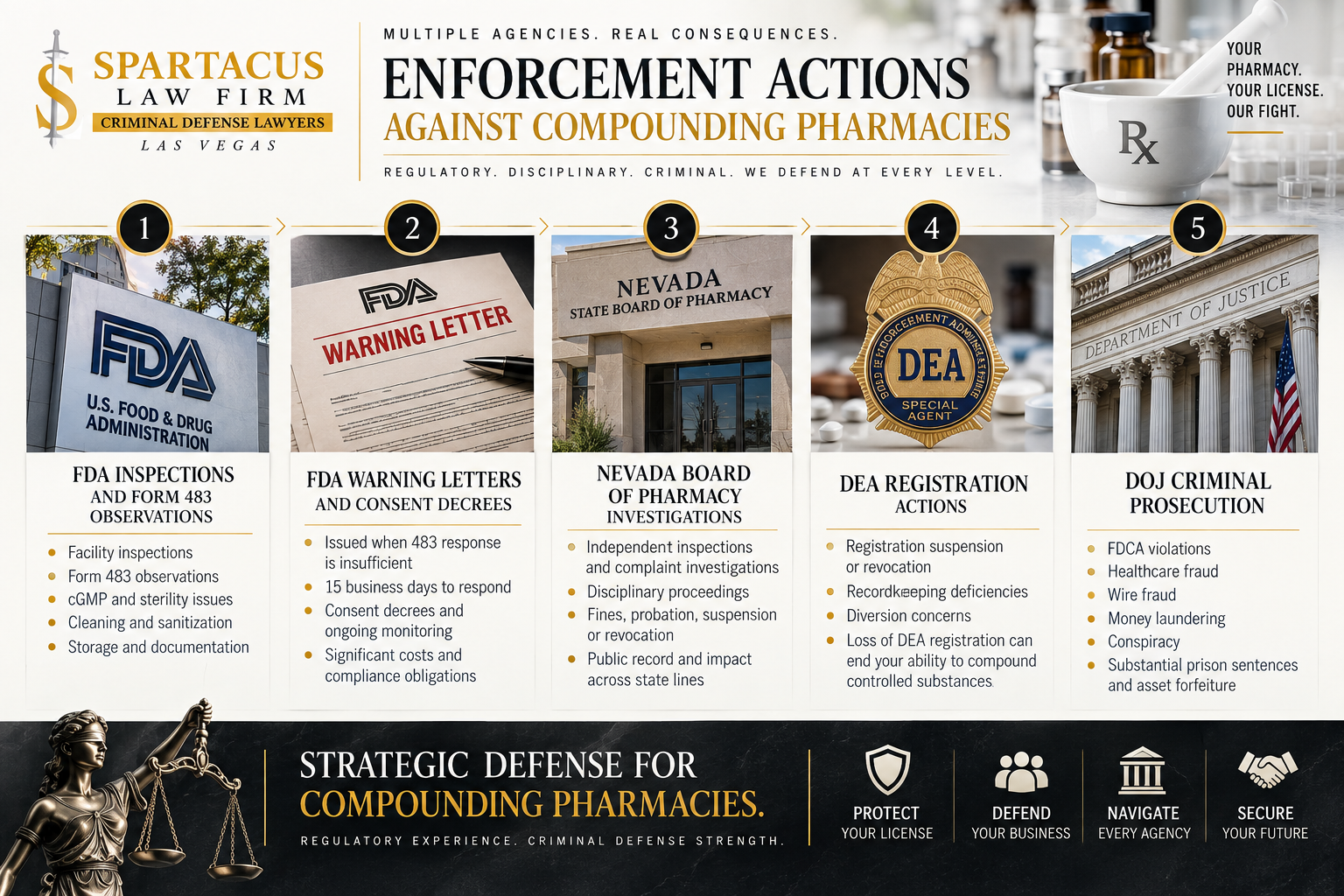
Compounding pharmacies face enforcement from multiple agencies, often simultaneously. Spartacus Law Firm defends compounders against every type of enforcement action, including those described below.
FDA Inspections and Form 483 Observations
FDA inspections of compounding pharmacies, whether triggered by a complaint, a routine risk-based schedule, or a targeted enforcement campaign, frequently result in Form 483 observations. Common findings include failures in environmental monitoring, inadequate sterility testing, deficiencies in cleaning and sanitization procedures, improper storage conditions, incomplete batch records, failure to investigate out-of-specification results, and inadequate personnel training. Your response to a Form 483 is your best opportunity to prevent escalation to a Warning Letter.
FDA Warning Letters and Consent Decrees
When a pharmacy’s response to a Form 483 is insufficient, or when the violations are serious enough to warrant immediate formal action, the FDA issues a Warning Letter demanding corrective action within fifteen business days. If the Warning Letter response does not resolve the matter, the FDA may pursue a consent decree, a court-supervised agreement that imposes ongoing compliance obligations, independent monitoring, and significant costs. Our firm handles Warning Letter responses and consent decree negotiations with the same precision we bring to trial preparation.
Nevada Board of Pharmacy Investigations
The Nevada Board of Pharmacy conducts its own inspections of compounding pharmacies and investigates complaints from patients, other healthcare providers, and federal agencies. Board investigations can result in formal disciplinary proceedings, including fines, probation, license suspension, or license revocation. For individual pharmacists, board discipline is published on national licensure databases and follows you across state lines for the duration of your career.
DEA Registration Actions
Compounding pharmacies that handle controlled substances operate under DEA registration. The DEA can initiate registration suspension or revocation proceedings based on recordkeeping deficiencies, diversion concerns, or violations identified during inspections. Loss of DEA registration effectively prevents a pharmacy from handling any controlled substance, which for many compounding operations means the end of the business.
DOJ Criminal Prosecution
In the most serious cases, federal enforcement against compounding pharmacies takes the form of criminal prosecution by the Department of Justice. Criminal charges in compounding cases can include violations of the Federal Food, Drug, and Cosmetic Act, healthcare fraud under 18 U.S.C. 1347, wire fraud, money laundering, and conspiracy. Penalties include substantial prison sentences, forfeiture of assets, and permanent exclusion from federal healthcare programs. As a criminal defense firm at our foundation, Spartacus Law Firm handles both the regulatory and criminal tracks simultaneously.
GLP-1 and Peptide Compounding: The Current Enforcement Landscape
The compounding of GLP-1 receptor agonists, particularly semaglutide and tirzepatide, has become the most actively enforced category in FDA compounding oversight. Compounding pharmacies that supplied these medications under the FDA’s drug shortage exception now face a fundamentally different regulatory reality. As shortage designations expire, the legal basis for compounding these products evaporates, and the FDA has moved aggressively to enforce that boundary.
Beyond GLP-1 medications, the FDA has placed numerous peptide substances, including BPC-157, ipamorelin, CJC-1295, AOD-9604, and others, on the Category 2 list under Section 503A, identifying them as substances that present demonstrable safety concerns and are prohibited from being compounded for human use. Compounding pharmacies in the Las Vegas area that continue to prepare these substances face Warning Letters, product seizures, and criminal exposure.
Our peptide and healthcare regulatory defense practice is specifically built to handle the overlap between compounding pharmacy defense, peptide enforcement, and the evolving FDA guidance that governs this space. If your pharmacy has received an FDA communication related to GLP-1 or peptide compounding, do not respond without legal counsel.
What Spartacus Law Firm Does for Compounding Pharmacy Clients
Our defense of compounding pharmacies begins before the enforcement action and continues through resolution. We are engaged by clients at every stage, from pre-inspection compliance planning to post-hearing appeals, and our approach is shaped by the understanding that every regulatory matter carries potential criminal exposure.
Pre-Inspection Compliance Review
We work with compounding pharmacies to identify and correct compliance vulnerabilities before an FDA or state board inspection occurs. This includes reviewing standard operating procedures, documentation practices, environmental monitoring protocols, personnel training records, and bulk drug substance sourcing, all through the lens of what an FDA investigator or Board inspector will be looking for.
Form 483 and Warning Letter Response
We draft responses to Form 483 observations and Warning Letters that address the FDA’s concerns with specific, documented corrective actions while protecting the pharmacy from unnecessary admissions. Every response is reviewed for both regulatory adequacy and criminal liability exposure before submission.
Nevada Board of Pharmacy Defense
We represent pharmacists and pharmacy owners before the Nevada Board of Pharmacy in investigations, settlement negotiations, and formal administrative hearings. Our goal in every board matter is to resolve the issue at the earliest possible stage, ideally before a formal complaint is filed, and to protect the licensee’s ability to continue practicing.
Parallel Federal and State Defense
When a compounding pharmacy faces enforcement from multiple agencies, whether that is a simultaneous FDA Warning Letter and Board of Pharmacy investigation, or a DEA registration action paired with a DOJ criminal inquiry, coordinating the defense across forums is essential. Spartacus Law Firm handles all tracks under one roof, eliminating the coordination failures and strategic blind spots that arise when multiple firms are involved.
Consent Decree and Injunction Defense
If the matter escalates to a consent decree negotiation or an injunction proceeding in federal court, we defend our clients’ interests with the same intensity we bring to criminal trial preparation. Consent decree terms are negotiable, and the difference between a well-negotiated decree and a poorly negotiated one can be the difference between a pharmacy that survives and one that closes permanently.
Do not wait for the next enforcement letter. Call (702) 660-1234 now to schedule your confidential consultation. Or contact us online for a prompt response.
Protecting Your Professional License in a Compounding Investigation
For individual pharmacists and pharmacy owners, a compounding pharmacy investigation threatens more than the business. It threatens the professional license that represents years of education, training, examination, and professional investment. The Nevada Board of Pharmacy has broad disciplinary authority, and a finding of compounding violations can result in license probation, suspension, or revocation.
The stakes extend beyond pharmacy licenses. Physicians who prescribe compounded medications may face investigation by the Nevada State Board of Medical Examiners if the compounding pharmacy they use comes under scrutiny. Dentists prescribing compounded preparations, nurses administering compounded drugs, and medical license holders of every type can find their professional standing jeopardized by association with a pharmacy under federal investigation.
Spartacus Law Firm defends both the pharmacy and the individual practitioners whose licenses are at risk. We coordinate the pharmacy’s regulatory defense with the individual license defense of every affected provider, ensuring that one defense track does not inadvertently create exposure in the other.

Frequently Asked Questions About Compounding Pharmacy Defense
What is the difference between a 503A pharmacy and a 503B outsourcing facility?
A 503A pharmacy compounds medications based on individual patient-specific prescriptions and is primarily regulated by the state board of pharmacy. A 503B outsourcing facility compounds drugs without requiring individual prescriptions and may distribute directly to healthcare providers for office use or hospital stock. In exchange for this broader distribution authority, 503B facilities must register with the FDA, comply with cGMP requirements, submit to FDA inspections, and report adverse events. The regulatory burden on 503B facilities is substantially greater, and the enforcement consequences for non-compliance are more severe. Many of the FDA’s most aggressive enforcement actions target pharmacies that are operating under 503A but whose practices the agency characterizes as manufacturing, which would require 503B registration.
Can the Nevada Board of Pharmacy revoke my license for compounding violations?
Yes. The Nevada Board of Pharmacy has the authority to revoke, suspend, or place conditions on a pharmacist’s license for violations of state and federal compounding regulations. Board actions can include formal reprimand, mandatory continuing education, probation with practice restrictions, suspension, and permanent revocation. Board discipline is reported to national databases, affecting your ability to obtain or maintain licensure in other states. Engaging an experienced pharmacy defense attorney at the earliest stage of a Board investigation gives you the best opportunity to resolve the matter before formal charges are filed.
What triggers an FDA inspection of a compounding pharmacy?
FDA inspections of compounding pharmacies can be triggered by several factors, including adverse event reports, patient complaints, referrals from state boards of pharmacy, the pharmacy’s risk-based inspection schedule (for 503B facilities), and targeted enforcement campaigns focused on specific drug categories such as GLP-1 compounding or peptides. The FDA may also inspect a pharmacy based on intelligence gathered from its monitoring of marketing materials, websites, and social media. Regardless of the trigger, you should treat any FDA inspection as a serious regulatory event and contact legal counsel as soon as you receive notice.
Can compounding violations lead to criminal charges?
Yes. Federal criminal prosecution of compounding pharmacy violations has increased significantly in recent years. The Department of Justice has prosecuted compounders under the Federal Food, Drug, and Cosmetic Act for manufacturing and distributing adulterated or misbranded drugs, as well as under healthcare fraud, wire fraud, and conspiracy statutes. The 2012 New England Compounding Center case, which resulted in criminal convictions and lengthy prison sentences for pharmacy executives, demonstrated the severity of criminal exposure in compounding cases. Spartacus Law Firm treats every compounding pharmacy enforcement matter as a case with potential criminal implications, preserving every defense from the very first day.
How quickly do I need to respond to an FDA Warning Letter about compounding?
The FDA typically requires a written response within fifteen business days of receipt. That response must address each specific violation identified in the Warning Letter with documented corrective actions, implementation timelines, and supporting evidence. A late or incomplete response signals to the FDA that the violations are continuing and substantially increases the likelihood of escalation to a consent decree, injunction, or criminal referral. Spartacus Law Firm begins preparing your response immediately upon engagement, working to meet the deadline while ensuring that every statement in the response is both technically accurate and legally sound.
Schedule Your Confidential Consultation Today
The regulatory landscape for compounding pharmacies in Las Vegas and throughout Nevada is more challenging today than at any point since the DQSA was enacted. FDA enforcement is accelerating, state board scrutiny is intensifying, and the criminal exposure that accompanies compounding violations is expanding. Whether you are responding to a Form 483, preparing for an upcoming inspection, defending against a Board of Pharmacy investigation, or facing a DOJ referral, Spartacus Law Firm is ready to protect your pharmacy, your license, and your livelihood.