
FDA Warning Letter Defense Lawyer
License Board Resources
Contact Us
Experienced FDA Warning Letter Defense Lawyer in Las Vegas
An FDA Warning Letter is not a suggestion. It is a formal enforcement action from the most powerful regulatory agency in American healthcare, and it demands a precise, strategic response within fifteen business days. If you are a pharmacist, pharmacy owner, physician, compounder, or healthcare business operator in Las Vegas or anywhere in Nevada who has received a Warning Letter, a Form 483 inspection observation, or a notice of a pending FDA enforcement action, the decisions you make in the next two weeks will determine whether this matter resolves quietly or escalates into a consent decree, product seizure, injunction, or criminal prosecution.
At Spartacus Law Firm, we defend healthcare professionals and regulated businesses against the full range of FDA enforcement actions. Attorney Chandon S. Alexander, recognized among the Top 10 Criminal Defense Attorneys Under 40 and an active member of the Clark County Bar Association, the American Bar Association, and the Nevada Justice Association, brings a defense approach built specifically for practitioners operating in the most aggressively regulated sectors of modern healthcare.
If you have received an FDA Warning Letter, call (702) 660-1234 now. Your response window is already running.
What Is an FDA Warning Letter?
An FDA Warning Letter is a written notification issued by the Food and Drug Administration when the agency identifies what it considers significant violations of federal law or regulation. According to the FDA’s own guidance, Warning Letters are issued after the agency has completed an inspection, reviewed evidence, and concluded that a regulated entity has failed to comply with applicable requirements. The letter identifies the specific violations, requests a written response outlining corrective actions, and sets a deadline, typically fifteen business days from the date of receipt.
What many recipients do not understand is that the FDA publishes every Warning Letter on its public database. The moment your Warning Letter is posted, your name, your business, and the allegations against you are visible to patients, competitors, state licensing boards, insurers, and the general public. That public exposure creates a cascade of secondary consequences that extend far beyond the FDA’s own enforcement. The Nevada Board of Pharmacy monitors FDA actions involving Nevada licensees, and a published Warning Letter can trigger an independent state board investigation.
A Warning Letter is not a final agency action. It does not impose a fine or shut down your operation on its own. But it is an unmistakable signal that the FDA considers you in violation, and the agency fully expects corrective action. If your response is inadequate, late, or missing, the FDA will escalate. That escalation can take the form of a consent decree, a product seizure under federal authority, an injunction barring you from operating, debarment from government healthcare programs, or a referral to the Department of Justice for criminal prosecution.
How FDA Warning Letters Affect Las Vegas Healthcare Providers
Clark County is home to the largest concentration of healthcare facilities, pharmacies, compounding operations, and medical practices in Nevada. The Las Vegas metropolitan area supports thousands of licensed pharmacists, physicians, nurses, and allied health professionals, along with a growing number of compounding pharmacies, wellness clinics, and telehealth operations that serve patients across state lines. That scale of regulated activity draws corresponding FDA attention.
For a Las Vegas pharmacist or pharmacy owner, an FDA Warning Letter can threaten your state license, your DEA registration, your contracts with wholesalers and insurance networks, and your ability to continue operating. For a physician or prescriber, a Warning Letter directed at a compounding pharmacy you use can trigger board investigation into your prescribing practices. For any healthcare provider in Nevada, the reputational damage of a publicly posted Warning Letter can be as devastating as the regulatory consequences.
Spartacus Law Firm understands the Nevada regulatory landscape because we practice in it daily. We know how the Nevada Board of Pharmacy responds to FDA findings, how Clark County healthcare providers are affected by federal enforcement trends, and how to coordinate a defense that addresses both the federal Warning Letter and any parallel state board exposure.
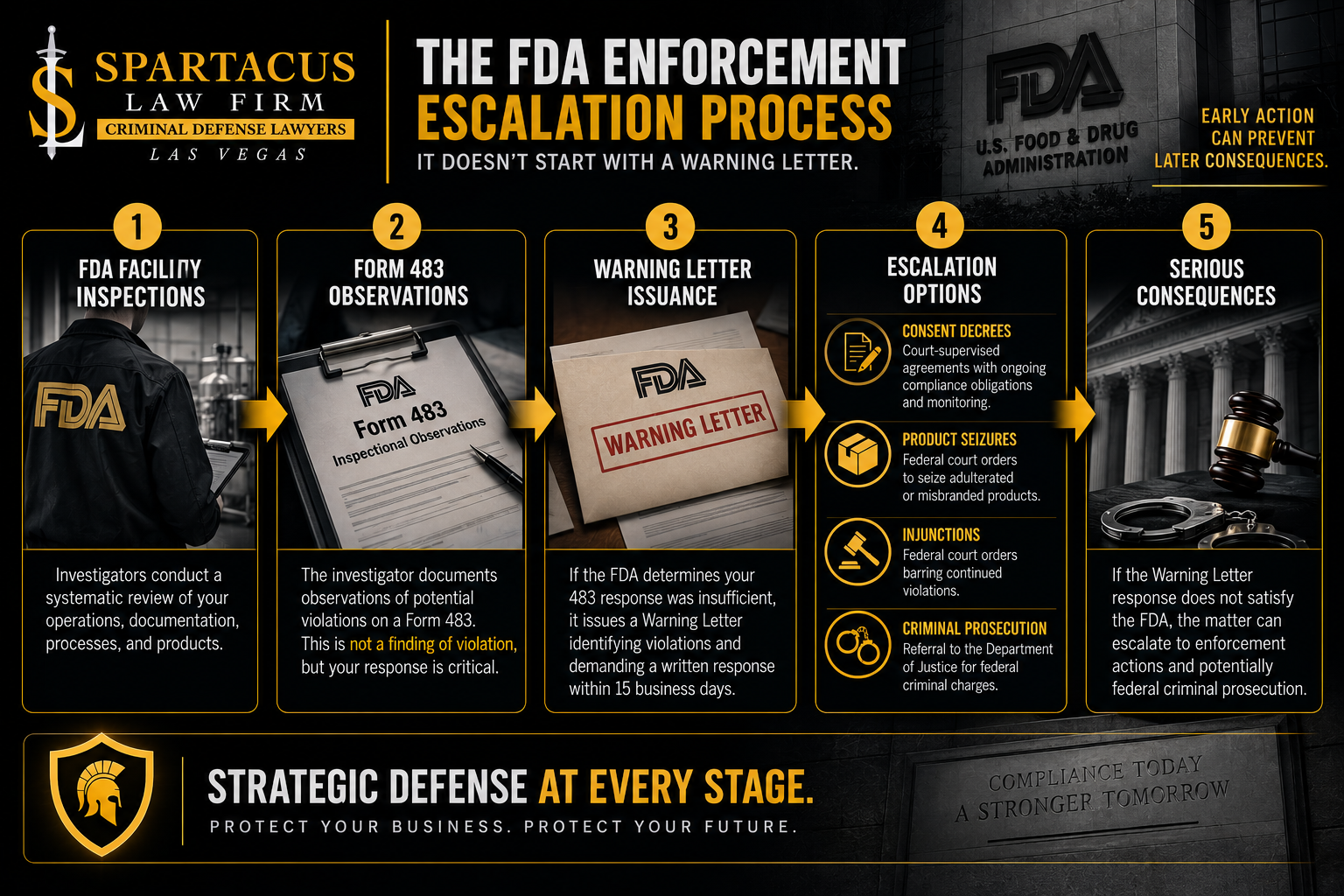
The FDA Enforcement Escalation Process
FDA enforcement does not begin with a Warning Letter. Understanding where the Warning Letter falls in the enforcement timeline is critical to mounting an effective defense.
FDA Facility Inspections
The process typically begins with an FDA facility inspection. Investigators arrive at your pharmacy, manufacturing facility, or clinic and conduct a systematic review of your operations, documentation, processes, and products. During the inspection, the investigator records observations of potential violations on an FDA Form 483. These observations are presented to you at the close of the inspection, and you have an opportunity to respond.
Form 483 Observations
A Form 483 lists specific observations the FDA investigator has documented during the inspection. Common observations include failures in current Good Manufacturing Practice (cGMP) compliance, inadequate quality control procedures, unsanitary conditions, inadequate documentation, labeling violations, and failures in sterility assurance. The Form 483 is not, by itself, a finding of violation. However, your response to the 483 shapes what comes next. An inadequate response, or no response at all, almost guarantees a Warning Letter.
Spartacus Law Firm advises clients to treat every Form 483 observation with the seriousness of a formal enforcement action. The response you provide at the 483 stage can prevent the matter from ever escalating to a Warning Letter. Our attorneys draft 483 responses that acknowledge identified issues, outline specific corrective actions with timelines, and demonstrate a commitment to sustained compliance, all while protecting you from unnecessary admissions.
Warning Letter Issuance
When the FDA determines that the 483 response was insufficient, or when the violations observed are serious enough to warrant immediate formal action, the agency issues a Warning Letter. The letter identifies the violations, cites the applicable federal statutes and regulations, and demands a written response within fifteen business days. That response must detail the specific corrective actions you have taken or plan to take, along with supporting documentation.
Escalation Beyond the Warning Letter
If the Warning Letter response does not satisfy the FDA, the agency has several escalation options. These include consent decrees, which are court-supervised agreements that impose ongoing compliance obligations and monitoring. They include product seizures, where the FDA obtains a federal court order to seize adulterated or misbranded products. They include injunctions, which are federal court orders barring a company or individual from continuing to violate the law. And in the most serious cases, the FDA refers the matter to the Department of Justice for federal criminal prosecution.
Types of FDA Warning Letters We Defend
Spartacus Law Firm defends healthcare professionals and businesses across the full spectrum of FDA Warning Letter categories. Each type of Warning Letter requires a different defense strategy because the underlying regulations, the agency’s enforcement priorities, and the potential consequences differ significantly.
cGMP and Manufacturing Violations
Current Good Manufacturing Practice violations are among the most common grounds for FDA Warning Letters. These letters target deficiencies in manufacturing processes, quality control systems, equipment maintenance, environmental monitoring, personnel training, and documentation. For compounding pharmacies in Las Vegas and throughout Nevada, cGMP violations can threaten both the pharmacy’s ability to operate and the pharmacist’s individual license with the Nevada Board of Pharmacy.
Adulteration and Misbranding
Warning Letters alleging adulteration under 21 U.S.C. 351 or misbranding under 21 U.S.C. 352 carry particularly serious consequences. Adulteration charges arise when the FDA determines that a drug product was manufactured under conditions that do not meet cGMP standards, or that the product itself is contaminated, subpotent, or otherwise defective. Misbranding charges arise when labeling is false, misleading, or fails to include required information. These allegations can form the basis for product seizures and criminal charges under federal law.
Compounding Pharmacy Violations
Compounding pharmacies operating under Section 503A or 503B of the Federal Food, Drug, and Cosmetic Act face a distinct set of FDA enforcement risks. Warning Letters in this category address unauthorized compounding of drugs on the FDA’s bulk substance restriction lists, failure to compound pursuant to valid patient-specific prescriptions, operating as an unlicensed manufacturer, and violations of the Drug Quality and Security Act (DQSA). Our peptide and healthcare regulatory defense practice is specifically built to handle these cases.
Unapproved New Drug Violations
The FDA issues Warning Letters when it determines that a product is being marketed as a drug without the required new drug approval. This is increasingly common in the peptide, supplement, and wellness product space. Companies and practitioners selling or prescribing products that make therapeutic claims without FDA approval face Warning Letters, product seizures, and potential fraud charges.
Crafting an Effective FDA Warning Letter Response
The Warning Letter response is the single most important document in an FDA enforcement matter. A well-crafted response can resolve the matter entirely. A poorly drafted response, or a response that arrives late, virtually guarantees escalation.
Spartacus Law Firm approaches every Warning Letter response with three objectives: address the FDA’s specific concerns with documented corrective actions, protect the client from unnecessary legal admissions that could be used in future enforcement proceedings, and position the client for the strongest possible outcome if the matter does not resolve at the Warning Letter stage.
Our Warning Letter response process includes:
- Detailed analysis of every violation cited in the Warning Letter and the underlying Form 483 observations
- Review of your facility’s operations, documentation, and compliance history to identify the root causes of the cited violations
- Development of a Corrective Action/Preventive Action (CAPA) plan with specific, documented remediation steps and implementation timelines
- Coordination with quality assurance consultants, pharmacists, and technical experts when specialized expertise is required
- Drafting a response that satisfies FDA expectations while avoiding admissions that could expose you to state board discipline, civil liability, or criminal prosecution
- Preparation for potential follow-up inspections and ongoing FDA correspondence
Many healthcare providers attempt to respond to Warning Letters without legal counsel, relying on in-house compliance staff or outside quality consultants. While those professionals play an important role, they are not trained to evaluate the legal implications of every statement in the response. A response that is technically sound but legally careless can hand the FDA, the DOJ, or a state licensing board the evidence it needs to take further action.
Consent Decrees and Beyond: When Warning Letters Escalate
A consent decree is a court-ordered agreement between the FDA and a regulated entity that imposes binding compliance obligations. Consent decrees typically require the company to cease certain operations, hire independent compliance monitors at its own expense, submit to regular inspections, and pay substantial costs. Violating a consent decree can result in contempt of court, additional penalties, and facility shutdown.
Spartacus Law Firm defends clients at every stage of FDA escalation. If you are already facing a consent decree negotiation, an injunction proceeding, or a DOJ referral, we have the federal criminal defense experience to protect your interests in both the regulatory and criminal forums simultaneously.
If a federal investigation has expanded beyond the regulatory sphere into potential white-collar criminal charges, including violations of the Federal Food, Drug, and Cosmetic Act, healthcare fraud under 18 U.S.C. 1347, wire fraud, or conspiracy, you need a defense team that understands how to manage parallel proceedings without allowing a misstep in one forum to create liability in the other.

Protecting Your Nevada Professional License After a Warning Letter
An FDA Warning Letter does not automatically trigger Nevada state board action, but in practice, it almost always does. The Nevada Board of Pharmacy actively monitors FDA enforcement actions against Nevada-licensed pharmacies and pharmacists. A published Warning Letter will likely prompt the Board to open its own investigation, request information from the licensee, and potentially initiate disciplinary proceedings.
For licensed pharmacists, this creates a two-front defense. The FDA expects a substantive response to its Warning Letter. The Nevada Board of Pharmacy expects cooperation with its own investigation. And the information you provide to one agency is discoverable by the other. Spartacus Law Firm coordinates both tracks, ensuring that your federal response supports your state-level defense and that your state-level cooperation does not create new federal exposure.
We provide the same coordinated defense for physicians, nurses, dentists, and other licensed professionals whose state licenses are jeopardized by FDA enforcement actions. Whether the Warning Letter targets your practice directly or a pharmacy or supplier you rely on, the downstream risk to your medical license is real and must be addressed proactively.
Why Las Vegas Healthcare Providers Choose Spartacus Law Firm
FDA enforcement defense requires a legal team that operates at the intersection of federal regulatory law, state licensing law, and criminal defense. Most attorneys practice in one of those areas. Spartacus Law Firm practices in all three, because in the healthcare enforcement space, these areas overlap constantly.
When a Las Vegas compounding pharmacy receives a Warning Letter alleging cGMP violations, that pharmacy faces an FDA response deadline, a potential Nevada Board of Pharmacy investigation, and the possibility of a DOJ criminal referral. Handling those three tracks with three different law firms creates coordination failures and strategic blind spots. Spartacus Law Firm handles all three, with one attorney who knows every fact of the case and one defense strategy designed to protect the client across every forum.
Our clients choose us because we offer:
- Direct access to Attorney Chandon S. Alexander throughout every stage of the matter
- Twenty-four-hour availability, because FDA response deadlines and investigator contacts do not follow business hours
- Deep experience defending healthcare professionals before the Nevada Board of Pharmacy, the Nevada State Board of Medical Examiners, and federal regulatory agencies
- A criminal defense foundation that prepares every regulatory response as though it could one day be reviewed by a federal prosecutor
- Proven results for healthcare providers throughout Clark County and Nevada
Your response deadline is already running. Call Spartacus Law Firm at (702) 660-1234 to schedule your confidential consultation today. You can also contact us online for a prompt response.
Frequently Asked Questions About FDA Warning Letter Defense
How long do I have to respond to an FDA Warning Letter?
The FDA typically requires a written response within fifteen business days from the date you receive the Warning Letter. This is not a flexible deadline. A late response signals to the FDA that you are not taking the matter seriously, and it significantly increases the likelihood of escalation. At Spartacus Law Firm, we begin working on your response immediately upon engagement, conducting a thorough review of the Warning Letter, the underlying Form 483 observations, your compliance documentation, and your operational history to craft a response that addresses every cited violation with specific, documented corrective actions.
Will my FDA Warning Letter be made public?
Yes. The FDA publishes Warning Letters on its public database, where they are accessible to anyone, including patients, competitors, state licensing boards, insurance networks, and the media. In Nevada, the Board of Pharmacy monitors this database and may initiate its own investigation upon learning of a Warning Letter issued to a Nevada licensee. The public nature of Warning Letters makes it critical to resolve the underlying issues quickly and to obtain a close-out letter from the FDA as soon as the corrective actions have been verified.
Can an FDA Warning Letter lead to criminal charges?
Yes. While a Warning Letter is a civil regulatory action, the violations it identifies can form the basis of a criminal referral to the Department of Justice. The Federal Food, Drug, and Cosmetic Act carries criminal penalties for manufacturing or distributing adulterated or misbranded drugs. Additional charges, including healthcare fraud, wire fraud, and conspiracy, may apply depending on the facts of the case. Spartacus Law Firm drafts every Warning Letter response with an awareness of potential criminal exposure, ensuring that your regulatory response does not create new vulnerabilities in a criminal proceeding.
What is the difference between a Form 483 and a Warning Letter?
A Form 483 is a list of observations documented by an FDA inspector during a facility inspection. It identifies potential violations but is not a final determination. A Warning Letter is a formal enforcement action issued after the FDA has reviewed the inspection findings and any 483 response, and has concluded that significant violations exist. The Form 483 is your first opportunity to address the FDA’s concerns and prevent escalation to a Warning Letter. Spartacus Law Firm recommends engaging legal counsel at the 483 stage whenever possible, because a strong 483 response can resolve the matter before a Warning Letter is ever issued.
What happens if I ignore an FDA Warning Letter?
Ignoring an FDA Warning Letter is one of the most damaging decisions a healthcare provider can make. The FDA interprets non-response as an indication that the violations are continuing and that the recipient does not intend to correct them. This interpretation virtually guarantees escalation to more aggressive enforcement, including consent decrees, product seizures, injunctions, and criminal referrals. Even if you believe the FDA’s findings are incorrect or overstated, a timely, well-drafted response is essential to preserving your rights and your ability to continue operating.
Schedule Your Confidential Consultation Today
Every FDA enforcement matter begins with a deadline. Whether you are responding to a Form 483, drafting a Warning Letter response, negotiating a consent decree, or facing a DOJ criminal referral, the work you do in the earliest days of the matter shapes every outcome that follows. Spartacus Law Firm is available twenty-four hours a day, seven days a week to help Las Vegas and Nevada healthcare providers protect their practices, their licenses, and their livelihoods.