



If you are selling, prescribing, or distributing peptides labeled “For Research Use Only,” you may believe that label creates a legal barrier between your business and the FDA. It does not. The FDA has made clear, through enforcement actions, federal prosecutions, and public guidance, that the words printed on a vial matter far less than the context surrounding the sale. And the context the agency is examining right now includes your website, your marketing materials, your bundled supplies, and your patient communications.
Between mid-2025 and early 2026, the FDA and the Department of Justice dismantled major segments of the peptide supply chain. Warehouses were raided. Founders were indicted. Vendors that had operated openly for years shut down overnight. The enforcement pattern is unmistakable, and it is accelerating.
This article explains the legal framework the FDA uses to look past the “Research Use Only” label, the enforcement actions that have reshaped the industry, and the steps you must take immediately if your practice or business has any connection to RUO peptides. If you are facing regulatory scrutiny, contact Spartacus Law Firm for a confidential consultation.
The FDA’s Intent-for-Human-Use Doctrine
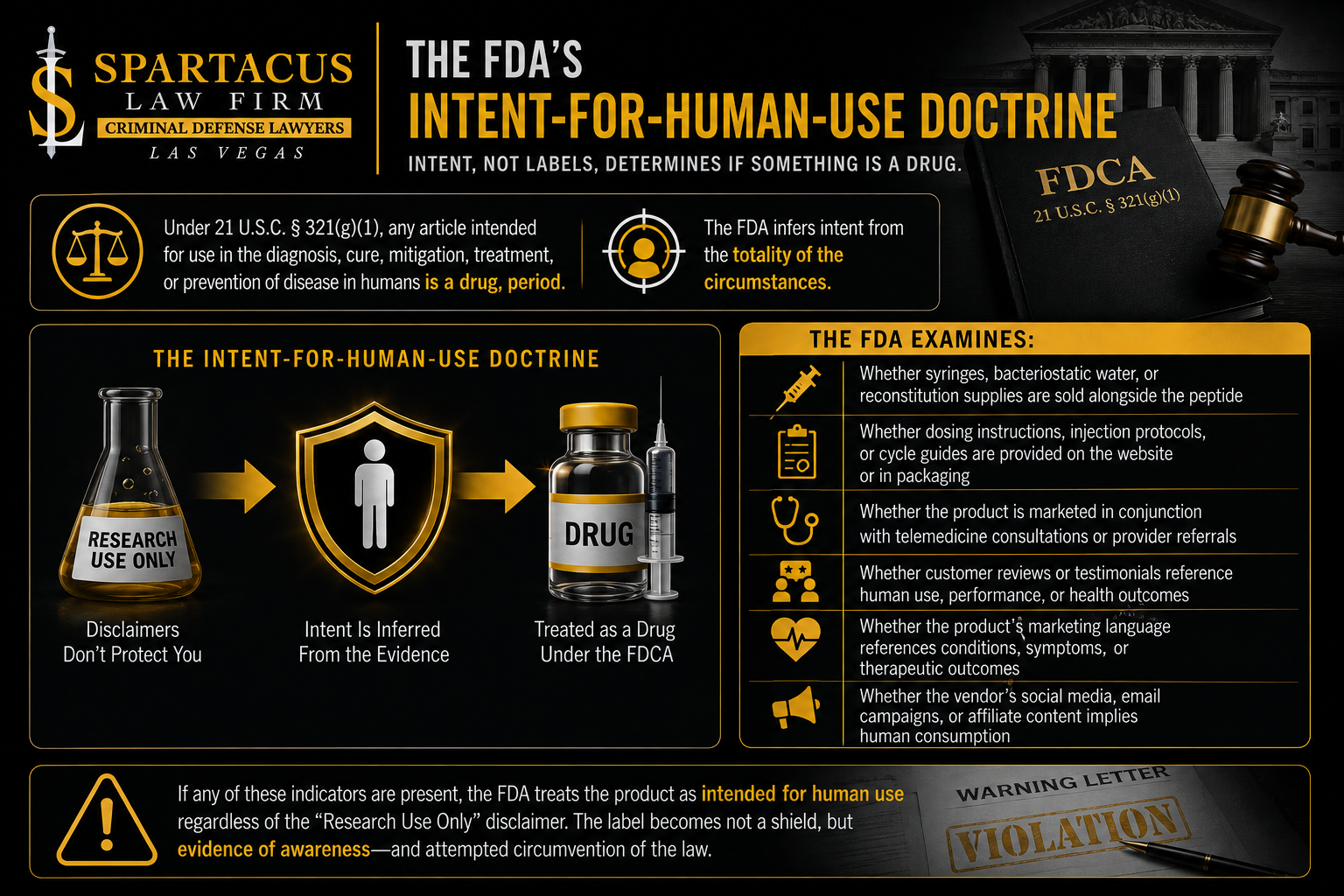
The Federal Food, Drug, and Cosmetic Act (FDCA) defines a “drug” based on intended use, not based on what the manufacturer writes on the label. Under 21 U.S.C. Section 321(g)(1), any article intended for use in the diagnosis, cure, mitigation, treatment, or prevention of disease in humans is a drug, period. The FDA does not need to prove you explicitly told customers to inject a product. The agency infers intent from the totality of the circumstances.
This is known as the intent-for-human-use doctrine, and it is the single most important concept for anyone in the peptide space to understand. The FDA examines:
- Whether syringes, bacteriostatic water, or reconstitution supplies are sold alongside the peptide
- Whether dosing instructions, injection protocols, or cycle guides are provided on the website or in packaging
- Whether the product is marketed in conjunction with telemedicine consultations or provider referrals
- Whether customer reviews or testimonials reference human use, performance, or health outcomes
- Whether the product’s marketing language references conditions, symptoms, or therapeutic outcomes
- Whether the vendor’s social media, email campaigns, or affiliate content implies human consumption
If any of these indicators are present, the FDA treats the product as intended for human use regardless of the “Research Use Only” disclaimer. The label becomes not a shield but evidence of awareness. It suggests the seller knew the product could be treated as a drug and attempted to circumvent the regulatory framework with a disclaimer.
How Bundling Supplies and Dosing Instructions Converts RUO Into an Unapproved Drug
The most common mistake vendors and providers make is assuming that selling a peptide with an RUO label, while simultaneously offering ancillary products and guidance that only make sense for human injection, creates some kind of legal separation. It does not.
When a vendor sells BPC-157 alongside insulin syringes, bacteriostatic water, alcohol swabs, and a PDF titled “Recommended Dosing Protocol,” the FDA treats the entire bundle as an unapproved new drug offering. The “research” label on the peptide vial is irrelevant because no reasonable person would purchase that bundle for laboratory research purposes.
This logic extends to providers. If you are a physician or nurse practitioner who purchases RUO peptides from a supplier, reconstitutes them in your office, and administers them to patients, you are distributing an unapproved drug. The fact that your supplier labeled the raw material “Research Use Only” does not transfer any legal protection to your clinical practice. If anything, it raises additional questions about why you were sourcing clinical materials from a supplier that explicitly disclaimed human use.
This is precisely the type of exposure that requires experienced criminal defense counsel who understands both FDA regulatory law and the healthcare industry.
The 2025-2026 Enforcement Wave: Case Studies
The FDA’s crackdown on RUO peptide vendors is not theoretical. It has already produced federal indictments, guilty pleas, asset forfeitures, and the closure of at least eight major vendors. Understanding these cases is essential for anyone assessing their own risk.
Amino Asylum
In June 2025, FDA agents executed a search warrant on the Amino Asylum warehouse. The investigation revealed that founders Matthew Kawa and Jennifer Stechkober had been selling peptides labeled “Research Use Only” while simultaneously providing dosing instructions, bundling injection supplies, and marketing products through channels that clearly targeted human users. On December 10, 2025, both founders pleaded guilty to federal charges related to the distribution of unapproved drugs. This case became the template for FDA enforcement in the peptide space and demonstrated that the agency was willing to pursue criminal prosecution, not just warning letters or civil injunctions.
Tailor Made Compounding
The Department of Justice prosecuted Tailor Made Compounding for distributing unapproved peptides, including BPC-157, to patients and providers nationwide. The company was forced to forfeit $1.79 million and entered into a consent decree that effectively ended its peptide operations. This case is particularly significant because Tailor Made operated as a compounding pharmacy, a category that typically enjoys certain regulatory protections under Section 503A and 503B of the FDCA. The prosecution made clear that compounding exemptions do not apply to peptides that the FDA has not approved for human use.
These cases illustrate the serious federal criminal exposure that can result from peptide distribution activities.
The Vendor Shutdown Wave
Between mid-2025 and early 2026, at least eight major peptide vendors ceased operations. Some closed voluntarily after receiving FDA warning letters or subpoenas. Others shut down after learning of the Amino Asylum prosecution. The list includes:
- Peptide Sciences, which voluntarily shut down in March 2026
- Paradigm Peptides
- Science.bio
- Royal Research
- Peptide Tech Labs
- American Research Labs
- Unchained Compounds
The speed and breadth of these closures signal that the industry itself recognizes the legal risk. Vendors with years of operational history and substantial revenue chose to close rather than face potential prosecution. If you are still selling RUO peptides or sourcing from vendors that remain operational, you should treat this pattern as a direct warning.

State-Level Enforcement: 40+ Attorneys General Demand Action
Federal enforcement is only part of the picture. More than 40 state attorneys general signed a joint letter demanding coordinated action against the sale of unapproved peptides. This letter called for enhanced enforcement, information sharing between state and federal agencies, and a unified approach to shutting down vendors operating across state lines.
For providers, this means exposure on two fronts. You may face federal prosecution under the FDCA and related statutes, and you may simultaneously face state-level action from your attorney general’s office, your state medical board, your state board of pharmacy, or other licensing authorities. State boards can and do initiate investigations based on referrals from federal agencies, and the joint letter all but guarantees that such referrals will increase.
If your practice involves peptide prescribing, it is critical to understand how drug crime defense intersects with regulatory compliance in this rapidly changing landscape.
Criminal Exposure: What You Could Be Charged With
The criminal exposure for selling, distributing, or prescribing RUO peptides for human use is substantial. Federal prosecutors have multiple statutes at their disposal, and they are using them.
- FDCA Violations (21 U.S.C. Section 331): Introducing or delivering for introduction an unapproved new drug into interstate commerce. This is the foundational charge in most peptide cases.
- Wire Fraud (18 U.S.C. Section 1343): If you used electronic communications, including websites, email marketing, or online payment processing, to sell products you knew or should have known were unapproved drugs, federal prosecutors can add wire fraud charges. Each transaction can constitute a separate count.
- Healthcare Fraud (18 U.S.C. Section 1347): If peptides were billed to insurance, or if the prescribing was connected to a healthcare program, healthcare fraud charges may apply. This carries a maximum sentence of 10 years per count.
- Conspiracy (18 U.S.C. Section 371): If you worked with suppliers, other providers, or marketing partners to distribute RUO peptides, conspiracy charges can attach to everyone in the chain.
These charges can be brought individually or stacked. In practice, federal prosecutors often bring multiple counts to create leverage during plea negotiations. The financial penalties alone can be devastating, but the real risk for healthcare providers is the cascading effect: a federal conviction triggers automatic review by state licensing boards, which can result in the loss of your professional license.
This combination of federal prosecution and licensing consequences is why experienced white collar crime defense counsel is essential.
Marketing Audit Checklist for Providers
If your practice currently sells, prescribes, or references peptides, you should conduct an immediate audit of your marketing materials and business practices. The following checklist identifies the red flags the FDA looks for when determining intent for human use.
- Website content: Does your site reference specific peptides by name alongside health conditions, symptoms, or therapeutic outcomes? Remove this content immediately.
- Bundled products: Are you selling peptides alongside syringes, bacteriostatic water, alcohol swabs, or other injection supplies? Unbundle these offerings.
- Dosing instructions: Do you provide dosing protocols, injection guides, cycle recommendations, or reconstitution instructions? These are the strongest indicators of intent for human use.
- Telemedicine integration: Are peptide products offered in conjunction with telemedicine consultations? This combination is a high-priority enforcement target.
- Customer communications: Review your email campaigns, SMS messages, and social media posts for language that implies human use or therapeutic benefit.
- Testimonials and reviews: Customer testimonials that reference personal use, health improvements, or performance gains create intent evidence even if you did not write them.
- Affiliate and influencer content: Content created by affiliates or influencers promoting your products for human use can be attributed to your business.
- Payment processing records: Review transaction records for patterns that suggest consumer rather than research purchases.
For healthcare providers specifically, this audit should also include a review of patient records, prescribing documentation, and any communications with peptide suppliers. Professional license defense attorneys can help you understand what records may be subject to production in an investigation.
What to Do If You Are Currently Selling RUO Peptides
If you are currently selling, prescribing, or distributing peptides labeled “Research Use Only” and you recognize your business in any of the scenarios described above, you need to take action now. Do not wait for a warning letter, a subpoena, or a knock on the door.
- Stop selling immediately. Continuing to sell RUO peptides after the Amino Asylum prosecution and the vendor shutdown wave eliminates any argument that you were unaware of the regulatory risk.
- Preserve all records. Do not delete emails, website content, transaction records, or supplier communications. Destruction of evidence after you become aware of potential enforcement action can result in separate obstruction charges.
- Conduct the marketing audit. Use the checklist above to identify and document every piece of content that could establish intent for human use.
- Retain experienced counsel. You need an attorney who understands both FDA regulatory law and criminal defense. General business attorneys are not equipped to handle the intersection of healthcare regulation, federal criminal exposure, and professional licensing that defines these cases.
- Do not speak to investigators without counsel. If the FDA, DOJ, or a state agency contacts you, do not provide a statement, produce documents, or consent to a search without first consulting your attorney.
If you are a physician facing scrutiny related to peptide prescribing, the intersection of criminal exposure and licensing risk makes early legal intervention essential.
Protect Your Practice and Your License
The FDA’s enforcement posture toward RUO peptides has shifted from regulatory guidance to criminal prosecution. The “Research Use Only” label that vendors relied on for years has been exposed as legally meaningless when the surrounding circumstances indicate intent for human use. Providers and vendors who fail to adjust are placing their freedom, their finances, and their professional licenses at risk.
Chandon S. Alexander, Esq. and the team at Spartacus Law Firm represent healthcare providers and businesses facing FDA enforcement actions, federal criminal investigations, and professional licensing proceedings related to peptide distribution. Recognized among the Top 10 Criminal Defense Attorneys Under 40, Mr. Alexander is a member of the Clark County Bar Association, the American Bar Association, and the Nevada Justice Association.
Call (702) 660-1234 any time, 24/7. Spartacus Law Firm has two Las Vegas locations: Downtown at 400 S 7th Street, Suite 100, Las Vegas, NV 89101, and the Howard Hughes office at 3993 Howard Hughes Parkway, Suite 480, Las Vegas, NV 89169.
Contact Spartacus Law Firm today for a confidential consultation about your peptide-related legal exposure.