

You just received a phone call, a letter, or an email from a board investigator. The message references your prescribing practices, your use of peptides, or a complaint filed against your license. Your stomach dropped. You are reading this because you need to know what to do right now.
Here is the most important thing you will read today: do not respond to the investigator until you have spoken with an attorney. Do not call them back. Do not send records. Do not write a letter explaining your side of the story. Everything you say and everything you produce becomes part of a permanent record that can and will be used against you in formal proceedings.
This guide walks you through what is happening, what your rights are, and exactly what to do in the first 48 hours after contact. If you need immediate help, call Spartacus Law Firm at (702) 660-1234. We are available 24/7.
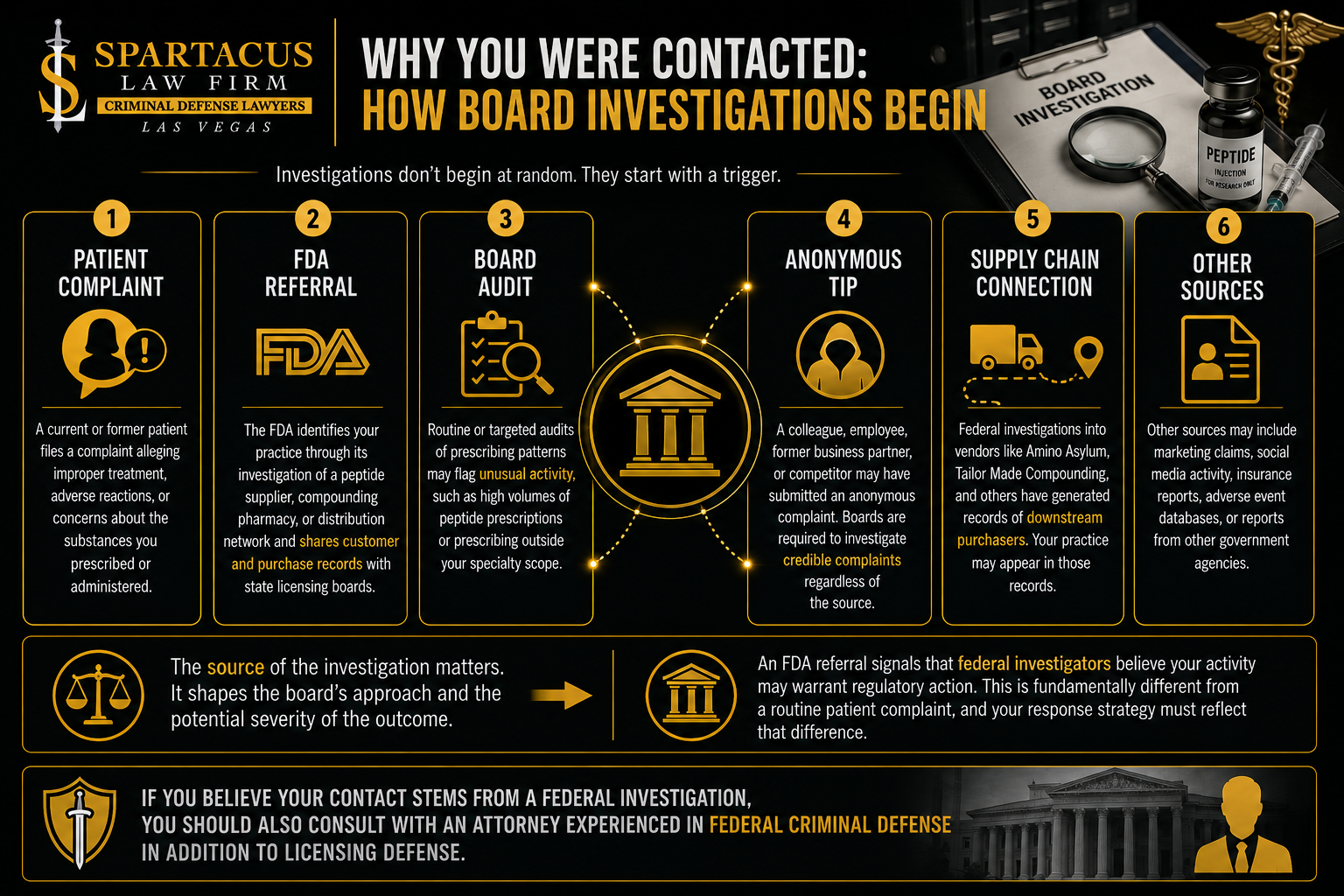
Why You Were Contacted: How Board Investigations Begin
Board investigations do not begin at random. Understanding how and why the investigator reached out to you is the first step in assessing your situation. Investigations into peptide prescribing are typically initiated through one of the following channels.
- Patient complaint. A current or former patient filed a complaint with your licensing board alleging improper treatment, adverse reactions, or concerns about the substances you prescribed or administered.
- FDA referral. The FDA identified your practice through its investigation of a peptide supplier, compounding pharmacy, or distribution network. When the FDA shuts down a vendor or prosecutes a distributor, it shares customer and purchase records with state licensing boards. If you purchased from a vendor that is now under federal investigation, the board may have received your name and transaction history directly from federal investigators.
- Board audit. Some boards conduct routine or targeted audits of prescribing patterns. If your prescribing data shows unusual patterns, such as high volumes of peptide prescriptions, prescriptions for compounds not approved for human use, or prescribing outside your specialty scope, this may have triggered a review.
- Anonymous tip. A colleague, employee, former business partner, or competitor may have submitted an anonymous complaint. Boards are required to investigate credible complaints regardless of the source.
- Supply chain connection. This is increasingly common in the peptide space. Federal investigations into companies like Amino Asylum, Tailor Made Compounding, and other vendors have generated extensive records of downstream purchasers. If your practice appears in those records, you may be contacted even if you had no direct knowledge of the vendor’s legal problems.
The source of the investigation matters because it shapes the board’s approach and the potential severity of the outcome. An FDA referral, for example, signals that federal investigators believe your activity may warrant regulatory action. This is fundamentally different from a routine patient complaint, and your response strategy must reflect that difference.
If you believe your contact stems from a federal investigation, you should also consult with an attorney experienced in federal criminal defense in addition to licensing defense.
What NOT to Say to a Board Investigator
The single biggest mistake providers make when contacted by a board investigator is talking. Investigators are trained to sound casual, supportive, and reasonable. They may tell you they just need to “clear something up” or that cooperation will help resolve the matter quickly. This framing is designed to elicit statements before you have legal representation.
Here is what you should not do:
- Do not give a verbal or written statement. Anything you say to the investigator becomes part of the investigative file. It can be quoted in a formal complaint, used as the basis for additional charges, and presented at a hearing. Once a statement is in the record, it cannot be retracted or clarified without creating the appearance of inconsistency.
- Do not explain your prescribing rationale. You may feel the urge to explain that your peptide use was evidence-based, that patients consented, or that you followed appropriate protocols. While these facts may ultimately form part of your defense, presenting them without strategic context and without counsel reviewing the investigator’s specific questions can do more harm than good.
- Do not admit to anything. Even statements that seem innocuous, such as confirming that you purchased peptides from a particular vendor or that you prescribed BPC-157 to patients, can establish elements of a violation that the board would otherwise need to prove independently.
- Do not lie. If you feel you cannot answer truthfully without incriminating yourself, say nothing. Making false statements to a board investigator can result in additional charges, including charges for dishonesty or lack of candor that are independent of the underlying peptide complaint.
The correct response to any question from a board investigator is: “I take this matter seriously and I want to cooperate fully. I am retaining an attorney and will respond through counsel.” That is all you need to say.
What NOT to Produce Without Understanding the Scope
Investigators may request that you produce patient records, purchase records, prescribing logs, or other documentation. You have rights regarding these requests, and understanding them is critical.
- Do not hand over records on the spot. If an investigator appears at your office and asks for records, you are not required to produce them immediately. Request the demand in writing and consult with your attorney before producing anything.
- Do not produce records beyond the scope of the request. Investigators sometimes make broad, informal requests hoping you will produce everything in your possession. Your attorney can help you understand exactly what is required and ensure you do not waive any protections by over-producing.
- Do not alter, delete, or destroy any records. Once you are aware of an investigation, you have an obligation to preserve relevant documents. Altering or destroying records after receiving notice of an investigation can result in separate charges for spoliation or obstruction, which can be more damaging than the underlying complaint.
An experienced professional license defense attorney will review the scope of any records request, identify documents that may be privileged or outside the scope of the inquiry, and manage the production process to protect your interests.
Your Rights During a Board Investigation
Licensing board investigations are administrative proceedings, not criminal trials. However, you still have important rights that many providers do not realize they can exercise.
- Right to counsel. You have the right to be represented by an attorney at every stage of the investigation, from the initial contact through any formal hearing. You do not have to wait until charges are filed to retain counsel.
- Right to understand the complaint. You are generally entitled to know the nature of the complaint or the basis for the investigation. If the investigator will not tell you what the complaint involves, your attorney can submit a formal request for this information.
- Right to respond through counsel. You are not required to respond personally. Your attorney can submit a written response on your behalf, which allows for strategic framing and ensures that your statements are accurate, complete, and do not inadvertently create new issues.
- Right against self-incrimination. If the investigation involves conduct that could also result in criminal charges, which is increasingly common in peptide cases given the federal enforcement environment, your Fifth Amendment rights apply. Your attorney can assert these protections on your behalf.
Understanding these rights is particularly important for physicians, nurses, and pharmacists whose licenses are at stake.
The Difference Between an Inquiry and a Formal Accusation
Not every contact from a board investigator means you are facing formal charges. Understanding where you are in the process helps you calibrate your response.
Preliminary Inquiry or Complaint
At this stage, the board has received information suggesting a potential violation, and an investigator is gathering facts. This is an information-collection phase. The board has not made any determination about whether a violation occurred. Many investigations end at this stage if the investigator’s findings do not support further action.
This is also the stage where attorney intervention is most effective. A well-crafted response, supported by documentation and presented with strategic awareness of how the board evaluates these matters, can resolve the investigation before it escalates. Conversely, an unguided response at this stage can provide the board with exactly the evidence it needs to move forward.
Formal Accusation or Complaint
If the board determines that the evidence supports a violation, it issues a formal accusation (sometimes called a formal complaint or statement of charges). At this point, you are facing potential disciplinary action, which can include reprimand, probation, license suspension, or license revocation. The matter will proceed to a hearing unless resolved through negotiation.
The gap between these two stages is where experienced legal representation makes the most difference. Early intervention by an attorney who understands peptide healthcare regulatory defense can prevent an inquiry from becoming a formal accusation.
Timeline of a Typical Board Investigation
Board investigations do not move at the speed of criminal cases, but they are not slow either. Understanding the typical timeline helps you plan your response.
- Initial contact (Day 1): You receive a call, letter, or email from an investigator. The clock starts now.
- Response deadline (typically 15 to 30 days): Most boards give you a window to respond to the initial inquiry. Some provide as few as 10 business days. Your attorney can request extensions, but only if retained promptly.
- Investigation phase (1 to 6 months): The investigator gathers records, interviews witnesses, reviews prescribing data, and compiles a report. Your attorney can engage with the investigator during this phase to provide context and advocate for a favorable resolution.
- Board review (1 to 3 months): The board’s legal counsel or a review committee evaluates the investigator’s findings and determines whether to close the matter, issue an advisory letter, or file a formal accusation.
- Formal proceedings (if initiated, 3 to 12 months): If the board files a formal accusation, the matter proceeds to discovery, potential settlement negotiations, and ultimately a hearing before an administrative law judge or the board itself.
The total timeline from initial contact to resolution can range from a few months to over a year. Throughout this process, your license status may be affected. Some boards can impose interim restrictions or suspensions pending the outcome of the investigation.

How Early Intervention by an Attorney Can Resolve Matters Before Public Discipline
The most important thing to understand about board investigations is that outcomes are not predetermined. Many investigations, particularly those at the preliminary inquiry stage, can be resolved without public discipline, without a formal hearing, and without any lasting mark on your professional record.
An attorney experienced in professional license defense can:
- Submit a strategic written response that addresses the board’s specific concerns while protecting your legal interests
- Provide context that the investigator may not have, such as the clinical rationale for your prescribing decisions, relevant training and credentials, and patient consent documentation
- Negotiate with the board’s counsel to reach a resolution that avoids formal discipline, such as a private letter of concern, voluntary continuing education, or a practice modification agreement
- Identify procedural issues with the investigation that may warrant dismissal or narrowing of the inquiry
- Coordinate with criminal defense counsel if the investigation has parallel federal implications
The window for effective early intervention is narrow. Once the board moves past the inquiry stage and files a formal accusation, the range of available resolutions narrows significantly, and the likelihood of public discipline increases.
What Happens If You Ignore the Investigation or Respond Poorly
Some providers, overwhelmed by the stress of an investigation, choose to ignore it. Others respond without counsel in ways that make their situation worse. Both paths lead to predictable and avoidable outcomes.
Ignoring the Investigation
- Failure to respond to a board inquiry can be treated as a separate violation, often characterized as failure to cooperate or unprofessional conduct
- The board can proceed with its investigation and issue findings based entirely on the evidence it has collected, without your input or context
- Default outcomes are almost always worse than negotiated outcomes
Responding Without Counsel
- Statements you make become permanent parts of the record. If you later hire an attorney who identifies a better defense strategy, your earlier statements may contradict or undermine that strategy
- Over-production of records can give the board access to information it would not otherwise have obtained, expanding the scope of the investigation
- Emotional or defensive responses, while understandable, are almost always counterproductive in administrative proceedings where the board is evaluating your judgment and professionalism
State Board Proceedings vs. Criminal Proceedings
In the current enforcement environment, peptide-related conduct can trigger both state licensing action and federal criminal investigation simultaneously. Understanding the differences between these two tracks is essential.
- Standard of proof. Criminal cases require proof beyond a reasonable doubt. Board proceedings typically use a preponderance of the evidence standard (more likely than not) or, in some states, clear and convincing evidence. This lower standard means conduct that might not support a criminal conviction can still result in license discipline.
- Rules of evidence. Criminal proceedings follow strict rules of evidence, including protections against hearsay and requirements for authentication. Board proceedings have relaxed evidentiary rules. Hearsay is often admissible, and the rules of procedure are generally more flexible.
- Consequences. Criminal conviction can result in imprisonment, fines, and a permanent criminal record. Board discipline can result in license revocation, suspension, probation, fines, and public disclosure. For many providers, the loss of a professional license is the more devastating outcome because it ends a career.
- Coordination risk. Statements made in board proceedings can be obtained by criminal prosecutors. This is why the Fifth Amendment protection and the right to counsel are so important. Your attorney must coordinate your defense across both tracks to ensure that cooperation with the board does not create evidence for criminal prosecutors.
The intersection of these two systems is exactly why you need an attorney who handles both criminal defense and professional license defense.
The First 48 Hours: Your Step-by-Step Action Plan
If you have been contacted by a board investigator about peptide prescribing, here is exactly what to do.
Hour 1: Do not respond to the investigator.
Read the communication carefully. Note the investigator’s name, the board involved, any case or reference numbers, and any deadlines mentioned. Do not call back, do not reply to the email, and do not send any documents.
Hours 1 through 4: Call an attorney.
Contact an attorney who specifically handles professional license defense and understands the peptide regulatory landscape. General practice attorneys, even good ones, are not equipped for the intersection of FDA enforcement, state licensing law, and potential criminal exposure that defines these cases. Spartacus Law Firm handles these matters and is available 24/7 at (702) 660-1234.
Hours 4 through 24: Gather your records (do not produce them).
Working with your attorney, compile the following documents for internal review. Do not send any of these to the board without counsel’s direction:
Your prescribing records related to the peptides in question. Purchase records from any peptide suppliers. Patient consent forms. Any marketing materials, website content, or communications referencing peptides. Correspondence with suppliers, compounding pharmacies, or other vendors. Your professional continuing education records, particularly any training related to peptide therapy or regenerative medicine.
Hours 24 through 48: Develop a response strategy with your attorney.
Your attorney will review the investigator’s communication, assess the likely source and scope of the investigation, identify any parallel criminal exposure, and develop a response that protects your interests across all potential proceedings.
When to Call an Attorney: The Answer Is Immediately
There is no scenario in which waiting to retain an attorney improves your position. Every day that passes without legal representation is a day in which you might make a statement, produce a document, or take an action that compromises your defense.
If you have been contacted by a board investigator, you need an attorney now. If you have received a letter, a subpoena, or a formal complaint, you need an attorney now. If you have not been contacted yet but you know that you prescribed peptides sourced from vendors that are now under federal investigation, you need an attorney now. Proactive legal counsel before you are contacted is always better than reactive counsel after you have already responded.
You can review Spartacus Law Firm’s track record of defending healthcare providers in complex regulatory matters.
Get Help Now
Chandon S. Alexander, Esq. and the team at Spartacus Law Firm have the experience, the knowledge, and the availability to help you navigate a board investigation involving peptide prescribing. Recognized among the Top 10 Criminal Defense Attorneys Under 40, Mr. Alexander is a member of the Clark County Bar Association, the American Bar Association, and the Nevada Justice Association.
Call (702) 660-1234 right now, 24/7. Do not wait until Monday. Do not wait until the response deadline is a week away. The most effective defense begins the moment you are aware of the investigation.
Spartacus Law Firm has two Las Vegas locations: Downtown at 400 S 7th Street, Suite 100, Las Vegas, NV 89101, and the Howard Hughes office at 3993 Howard Hughes Parkway, Suite 480, Las Vegas, NV 89169.
Contact Spartacus Law Firm for an immediate, confidential consultation about your board investigation.