


The FDA’s classification system for compounded peptides has become one of the most consequential regulatory frameworks in healthcare, yet most providers who prescribe or dispense these substances do not fully understand how it works. That knowledge gap is creating serious legal exposure. Providers are making prescribing decisions based on incomplete information, outdated assumptions, or misleading interpretations from supplement vendors, and those decisions can result in federal criminal charges, state board discipline, or both.
This guide breaks down what the FDA’s Category 1 and Category 2 designations actually mean, how they relate to the 503A Bulks List, and why the April 2026 removal of twelve peptides from Category 2 does not mean what many providers think it means. If you are a physician, pharmacist, or clinic operator involved in peptide therapies, this information is essential to understanding your regulatory position.
Section 503A of the Federal Food, Drug, and Cosmetic Act
To understand the Category 1 and Category 2 distinction, you first need to understand the legal framework that makes compounding possible. Section 503A of the Federal Food, Drug, and Cosmetic Act provides an exemption from the standard FDA new drug approval process for certain compounded medications. Without this exemption, every compounded drug would technically be an unapproved new drug, and distributing it would violate federal law.
Section 503A allows licensed pharmacies to compound drugs for individual patients based on valid prescriptions, but only when specific conditions are met. The bulk drug substance used in compounding must satisfy at least one of three criteria. First, it can have an official monograph in the United States Pharmacopeia or National Formulary (USP/NF). Second, it can be a component of an FDA-approved drug product. Third, and most relevant to the peptide discussion, it can appear on the 503A Bulks List.
The 503A Bulks List is the mechanism through which FDA evaluates substances that do not meet either of the first two criteria. For many peptides, this is the only potential pathway to lawful compounding, which is why the classification decisions on this list carry enormous weight for providers and pharmacies involved in peptide and healthcare regulatory matters.
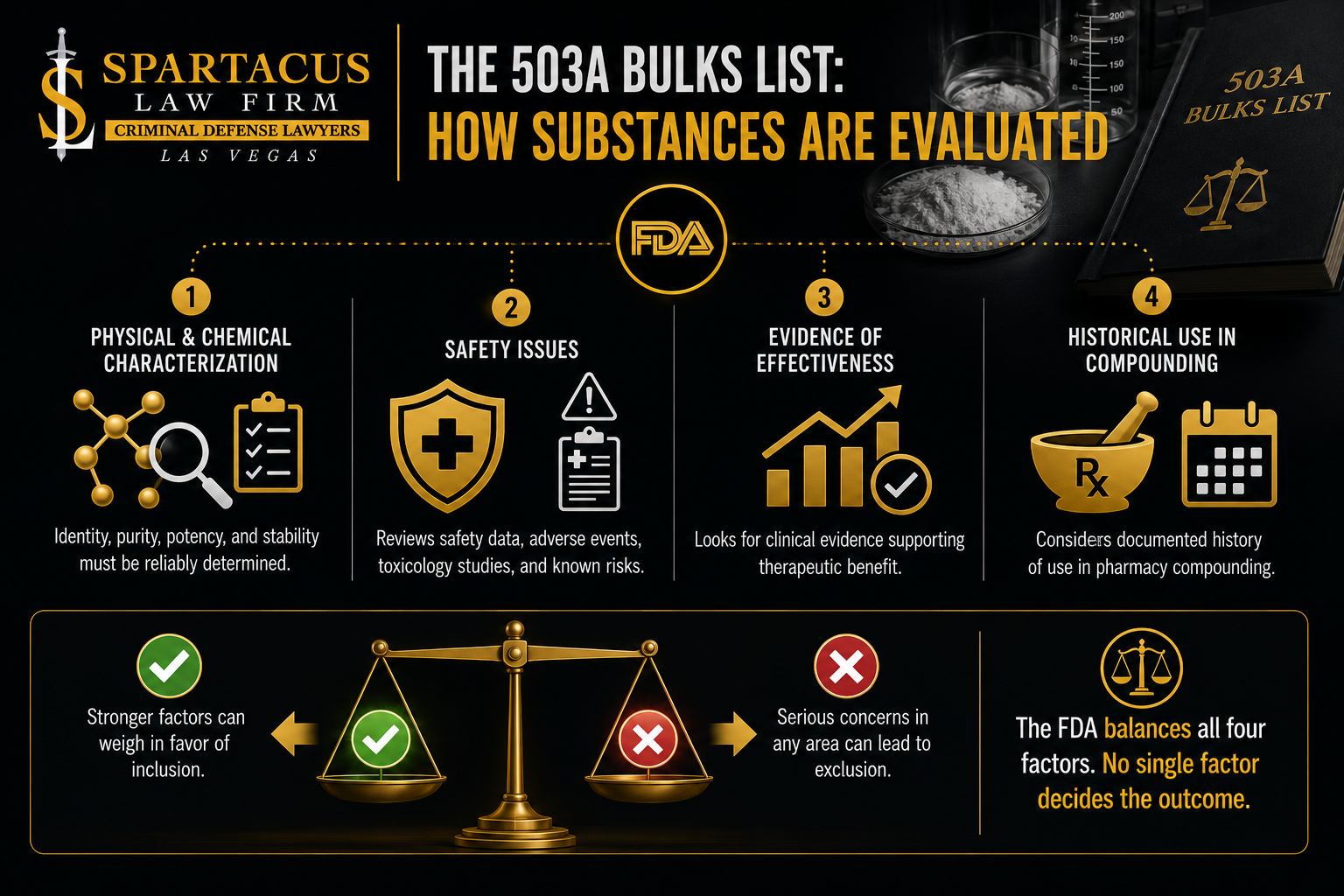
The 503A Bulks List: How Substances Are Evaluated
The FDA does not simply approve or reject substances for the 503A Bulks List based on a single criterion. Instead, the agency applies a multi-factor balancing test that considers four areas of evidence.
- Physical and chemical characterization. The FDA examines whether the substance is well-characterized, meaning its identity, purity, potency, and stability can be reliably determined. Substances that are poorly characterized present quality control risks in compounding environments.
- Safety issues. The agency reviews available safety data, including adverse event reports, toxicological studies, and known risks associated with the substance. A substance with significant safety signals faces a higher bar for inclusion.
- Evidence of effectiveness. FDA considers whether there is adequate evidence that the substance provides a therapeutic benefit. This does not require the same level of proof as a new drug application, but the agency does look for clinical evidence supporting the claimed uses.
- Historical use in compounding. The agency considers whether the substance has a documented history of use in pharmacy compounding. Substances with a long track record in compounding practice may receive more favorable consideration.
These factors are balanced against one another. A substance with excellent characterization and a long compounding history might still be excluded if it presents serious safety concerns. Conversely, a relatively newer substance with strong safety data and clear evidence of effectiveness might be favorably evaluated even with a shorter compounding history.
Category 1: What It Actually Means
Category 1 designation means the FDA has evaluated a substance under the multi-factor balancing test and determined that it will exercise enforcement discretion in favor of allowing compounding. In practical terms, Category 1 substances can be compounded by licensed pharmacies under Section 503A conditions. Providers who prescribe compounded formulations containing Category 1 substances are operating within a recognized legal framework.
It is important to understand what “enforcement discretion” means in this context. The FDA is not formally approving these substances as safe and effective drugs. Rather, the agency is stating that it will not take enforcement action against pharmacies that compound them, provided those pharmacies comply with all other 503A requirements. These requirements include compounding based on a valid, patient-specific prescription, operating under state pharmacy board oversight, and maintaining proper manufacturing standards.
Category 1 status provides a meaningful degree of legal protection, but it is not absolute. A pharmacy that compounds a Category 1 substance but violates other 503A conditions, such as compounding without individual prescriptions or distributing across state lines without proper registration, can still face enforcement action. Providers who prescribe these substances should verify that their compounding pharmacy is operating in full compliance.
Category 2: Prohibited Substances
Category 2 is the opposite of Category 1. When the FDA places a substance in Category 2, the agency has determined that the substance should not be compounded for human use. The FDA has identified safety concerns, inadequate characterization, insufficient evidence of effectiveness, or some combination of these factors that, in the agency’s judgment, makes compounding inappropriate.
Compounding a Category 2 substance is a violation of federal law. Pharmacies that compound these substances risk FDA enforcement actions including warning letters, injunctions, and criminal prosecution. Providers who knowingly prescribe Category 2 substances for compounding face potential exposure to drug-related criminal charges and professional licensing consequences.
The penalties are not hypothetical. The FDA has taken enforcement action against pharmacies that compound prohibited substances, and state boards have initiated disciplinary proceedings against providers connected to those pharmacies. For doctors and pharmacists alike, a Category 2 violation can trigger parallel state and federal proceedings.
Substances Not on Either List: The Regulatory Gray Area
One of the most misunderstood aspects of the FDA’s classification system is the status of substances that do not appear on either the Category 1 or Category 2 list. Many providers assume that if a substance is not explicitly prohibited (Category 2), it must be permitted. That assumption is wrong and potentially dangerous.
A substance that appears on neither list has not been evaluated and authorized for compounding under Section 503A. It has not been placed on the 503A Bulks List. Unless the substance has a USP/NF monograph or is a component of an FDA-approved drug product, there is no legal basis for compounding it under Section 503A. The fact that the FDA has not explicitly prohibited it does not create an affirmative authorization.
This distinction matters enormously for risk assessment. Providers who prescribe substances in this gray area and pharmacies that compound them are operating without a clear legal framework. If the FDA decides to take enforcement action, the absence of Category 2 designation will not serve as a defense. The relevant question is whether there is an affirmative legal basis for compounding, and for substances not on the 503A Bulks List, that basis generally does not exist.
The April 2026 Category 2 Removals: What Actually Happened
In April 2026, the FDA removed twelve peptides from Category 2. This decision generated significant attention in the peptide therapy community, with many providers, clinics, and compounding pharmacies interpreting it as a green light to resume compounding these substances. That interpretation is incorrect, and acting on it creates substantial legal risk.
Here is what the FDA actually did. The agency removed these peptides from the list of substances it has affirmatively identified as too dangerous to compound. That is all the removal accomplished. The FDA did not move these peptides to Category 1. The FDA did not add them to the 503A Bulks List. The FDA did not authorize their compounding under any framework.
The peptides removed from Category 2 include BPC-157, KPV, TB-500 (Thymosin Beta-4 fragment), MOTS-c, Emideltide, Semax, and Epitalon, among others. All of these substances are now scheduled for review by the Pharmacy Compounding Advisory Committee (PCAC) at its July 23-24, 2026 meeting. Until that review is complete and the FDA takes formal action based on PCAC’s input, these peptides exist in the regulatory gray area described above.
Any provider or pharmacy that resumes compounding these peptides based solely on their removal from Category 2 is making a decision that is not supported by the current regulatory framework. The legal exposure associated with that decision is significant, including potential white collar criminal charges for knowing violations of federal drug law.
The PCAC Advisory Process and Rulemaking Timeline
The Pharmacy Compounding Advisory Committee (PCAC) is an FDA advisory panel that provides recommendations on substances being considered for the 503A Bulks List. Its role in the process is advisory, not decisive. PCAC recommendations are non-binding. The FDA considers them as one input in its decision-making process, but the agency is not required to follow them.
Even after PCAC reviews a substance and makes a recommendation, the formal rulemaking process to add or remove a substance from the 503A Bulks List takes an additional 12 to 24 months. This timeline includes proposed rulemaking, public comment periods, and final rule publication. During this entire period, the substance’s legal status for compounding remains unchanged.
For the twelve peptides removed from Category 2 and scheduled for PCAC review in July 2026, this means that even the most favorable possible outcome at the PCAC meeting would not result in immediate authorization for compounding. Providers and pharmacies should plan for a timeline that extends well into 2027 or 2028 before any of these substances could potentially receive Category 1 designation through the formal rulemaking process.

Understanding the 503A vs 503B Distinction
An additional layer of complexity involves the difference between Section 503A and Section 503B compounding, which many providers conflate. The distinction is critical because the regulatory requirements and oversight mechanisms are fundamentally different.
503A compounding is performed by licensed pharmacies based on individual patient prescriptions. These pharmacies operate under state pharmacy board oversight and are not required to register with the FDA. The patient-specific prescription requirement is central to the 503A framework. It is what distinguishes traditional pharmacy compounding from drug manufacturing.
503B outsourcing facilities are a different category entirely. These facilities can compound drugs without individual patient prescriptions, allowing them to produce larger quantities for office use by healthcare providers. However, 503B facilities must register with the FDA and are subject to FDA inspection under current Good Manufacturing Practice (cGMP) standards. The regulatory burden is substantially higher, and the oversight is federal rather than state.
This distinction matters for providers because the source of a compounded peptide determines which regulatory framework applies, which enforcement body has jurisdiction, and what level of professional license risk the provider faces. A provider sourcing from a 503A pharmacy faces different exposure than one sourcing from a 503B outsourcing facility, and both face different exposure than one sourcing from an unregistered supplier.
What “Enforcement Discretion” Means in Practice
The term “enforcement discretion” appears frequently in FDA communications about compounding, but its practical meaning is often misunderstood. When the FDA says it will exercise enforcement discretion regarding a Category 1 substance, it means the agency has decided not to pursue enforcement action against parties who compound that substance in compliance with 503A or 503B requirements.
Enforcement discretion is not the same as legal authorization. The FDA can change its enforcement posture at any time. Enforcement discretion positions are not regulations and do not go through formal rulemaking. They can be revised or withdrawn through guidance documents, policy statements, or simply through the agency’s enforcement choices.
For substances in the regulatory gray area, including the twelve peptides recently removed from Category 2, the FDA has not announced any enforcement discretion position. The agency has not said it will refrain from taking action against pharmacies that compound these substances. The absence of a statement is not the same as a statement of forbearance.
Why This Confusion Creates Legal Risk for Providers
The complexity of this regulatory landscape has created a situation where many providers are making decisions based on fundamental misunderstandings. Some believe that removal from Category 2 equals authorization. Others believe that the absence of explicit prohibition equals permission. Still others rely on compounding pharmacies or peptide vendors to determine what is legally permissible, without recognizing that those parties have financial incentives that may not align with regulatory compliance.
The legal consequences for providers who get this wrong can be severe. Federal prosecutors can bring charges under the Food, Drug, and Cosmetic Act for introducing unapproved drugs into interstate commerce. State boards can initiate disciplinary proceedings against medical and pharmacy licenses. And because state board proceedings and federal investigations can run simultaneously, a provider may face parallel threats to both their liberty and their livelihood.
The providers most at risk are those who are prescribing peptides that were recently removed from Category 2 without waiting for formal regulatory resolution, those who are sourcing compounded substances from pharmacies or vendors that may not be operating in compliance, and those who have not sought legal counsel to evaluate their specific regulatory position.
Protect Your Practice. Talk to a Healthcare Regulatory Defense Attorney.
The peptide regulatory landscape is shifting rapidly, and the consequences of misreading FDA classifications can be career-ending. If you are a provider, pharmacist, or clinic operator involved in peptide therapies, you need to understand your exposure before enforcement decisions are made for you.
Spartacus Law Firm provides peptide and healthcare regulatory defense for providers and pharmacies throughout Nevada and nationwide. Attorney Chandon S. Alexander has been recognized among the Top 10 Criminal Defense Attorneys Under 40 and is a member of the Clark County Bar Association, the ABA, and the Nevada Justice Association. Review our case results to see the outcomes we have achieved for clients in complex regulatory matters.
Contact Spartacus Law Firm today for a confidential consultation. We are available 24/7 at (702) 660-1234, with offices in Downtown Las Vegas (400 S 7th Street, Suite 100, Las Vegas, NV 89101) and Howard Hughes Center (3993 Howard Hughes Parkway, Suite 480, Las Vegas, NV 89169).