

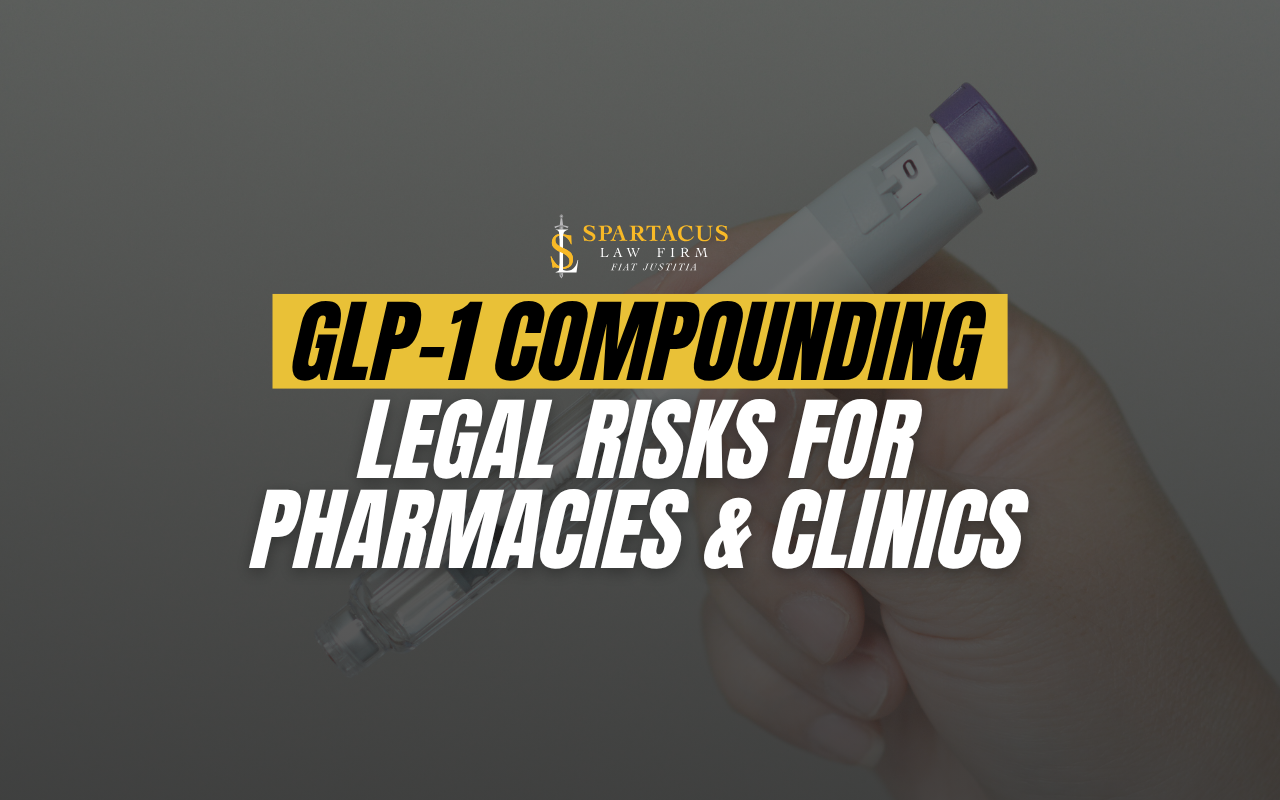

The compounded GLP-1 market exploded over the past three years, driven by massive consumer demand for weight loss medications, brand-name supply shortages, and the price gap between compounded formulations and FDA-approved products like Ozempic, Wegovy, Mounjaro, and Zepbound. At its peak, hundreds of compounding pharmacies, telehealth platforms, and weight loss clinics built their business models around compounded semaglutide and tirzepatide.
That market is now the subject of one of the most aggressive federal enforcement campaigns the compounding industry has ever seen. The FDA has issued more than 50 warning letters. Novo Nordisk and Eli Lilly have filed civil lawsuits against compounders. The International Trade Commission (ITC) has issued exclusion orders. And federal prosecutors have signaled that criminal charges under the FDCA, healthcare fraud statutes, and wire fraud statutes are on the table.
If you are a compounding pharmacy, prescribing provider, or clinic operator who has been involved in semaglutide or tirzepatide compounding, you need to understand the full scope of your legal exposure. This is not a matter of regulatory compliance adjustments. This is a matter of avoiding federal prosecution, civil judgments, and the loss of your professional license.
The FDA Shortage Exception: How Compounding Was Temporarily Permitted
Under Section 503A of the FDCA, compounding pharmacies may compound medications using bulk drug substances that appear on the FDA’s approved bulks list, provided they are compounding pursuant to valid patient-specific prescriptions. There is, however, a critical exception: when the FDA places a commercially available drug on its official drug shortage list, compounding pharmacies may compound copies of that drug even if the active ingredient is not on the approved bulks list.
This shortage exception is what allowed the compounded GLP-1 market to exist. Semaglutide and tirzepatide were both placed on the FDA drug shortage list due to supply constraints driven by extraordinary demand. While they remained on the shortage list, pharmacies that met the requirements of 503A or 503B could legally compound these medications.
The key word is while. The FDA has now largely resolved the supply shortages for both semaglutide and tirzepatide. As shortage designations are removed, the legal basis for compounding these drugs evaporates. Pharmacies that continue compounding after the shortage exception no longer applies are producing unapproved new drugs in violation of federal law.
This transition from permitted to prohibited is the central legal issue. Many pharmacies that began compounding under a legitimate shortage exception have continued operations after the legal authority to do so has expired. That continuation is not a gray area. It is a federal violation, and the FDA is treating it as one.
The September 2025 Warning Letters: 50+ Pharmacies Targeted
In September 2025, the FDA issued more than 50 warning letters to compounding pharmacies involved in GLP-1 receptor agonist production. This was one of the largest coordinated enforcement actions the FDA has taken against the compounding industry, and it established the enforcement framework that continues to guide federal action.
The warning letters focused on several categories of violations:
- False and misleading marketing claims. The FDA targeted pharmacies that described their compounded semaglutide or tirzepatide products as a “generic version” of branded drugs, as containing the “same active ingredient” as FDA-approved products, or as being “FDA-approved.” Each of these claims is false under federal law. Compounded drugs are not generic drugs. They have not undergone the bioequivalence testing required for generic approval. And characterizing them as equivalent to branded products is misleading to consumers and healthcare providers.
- Production of unapproved new drugs. Pharmacies that continued compounding after the shortage exception expired were cited for manufacturing and distributing unapproved new drugs, a core FDCA violation.
- CGMP failures. Several pharmacies received citations for failure to comply with Current Good Manufacturing Practice requirements, including inadequate quality controls, contamination risks, and insufficient testing of finished products.
A warning letter from the FDA is not merely advisory. It is a formal enforcement document that puts the recipient on notice. Failure to respond adequately and correct the violations identified in a warning letter dramatically increases the likelihood of injunction, seizure, or criminal referral. Pharmacies and providers who have received warning letters should immediately engage a federal crimes defense attorney.

Marketing Claims That Trigger Federal Enforcement
One of the most dangerous areas of exposure for compounding pharmacies and weight loss clinics is marketing. The FDA and FTC have been particularly aggressive in targeting specific claims that misrepresent the nature of compounded GLP-1 products. If your pharmacy or clinic has made any of the following claims, you are at elevated risk.
- Describing compounded semaglutide as a “generic” or “generic version” of Ozempic or Wegovy
- Stating that compounded products contain the “same active ingredient” as FDA-approved drugs
- Claiming compounded products are “FDA-approved” or “FDA-compliant”
- Using brand names (Ozempic, Wegovy, Mounjaro, Zepbound) in advertising to create the impression that compounded products are associated with or equivalent to these brands
- Claiming compounded formulations are “bioequivalent” or “therapeutically equivalent” without FDA-approved bioequivalence data
- Marketing compounded GLP-1 products directly to consumers without valid prescriptions
These marketing claims create multiple layers of legal exposure. They violate the FDCA’s prohibitions on misbranding and false labeling. They may constitute wire fraud under 18 U.S.C. 1343 if transmitted electronically. They can support healthcare fraud charges under 18 U.S.C. 1347 if the claims are used to bill insurance or government healthcare programs. And they expose providers to state pharmacy board and medical board disciplinary action, potentially resulting in loss of your professional license.
Manufacturer Civil Litigation: Novo Nordisk, Eli Lilly, and the ITC
The federal enforcement campaign against GLP-1 compounders is not limited to the FDA. The brand-name manufacturers themselves have launched aggressive civil litigation.
Novo Nordisk
Novo Nordisk, the manufacturer of semaglutide products (Ozempic, Wegovy, Rybelsus), has filed civil lawsuits against compounding pharmacies and telehealth platforms that compound and distribute semaglutide formulations. These lawsuits allege patent infringement, trademark infringement (through use of brand names in marketing), unfair competition, and violations of state consumer protection statutes. Novo Nordisk has substantial litigation resources and has signaled its intent to pursue every significant compounder in the market.
Eli Lilly
Eli Lilly, the manufacturer of tirzepatide products (Mounjaro, Zepbound), has pursued a similar litigation strategy. Lilly has also engaged the International Trade Commission (ITC), which has the authority to issue exclusion orders preventing the importation of infringing products. ITC exclusion orders are particularly significant because they can block the importation of bulk tirzepatide from overseas API suppliers, cutting off the supply chain for domestic compounders.
These civil actions carry significant financial exposure. Compounding pharmacies and clinics that lose these cases face damages, injunctive relief, and attorneys’ fees. And the discovery process in civil litigation can produce evidence that federal prosecutors subsequently use in criminal proceedings. The two tracks, civil and criminal, are not independent. They feed each other.
Criminal Exposure: FDCA, Healthcare Fraud, Wire Fraud, and Beyond
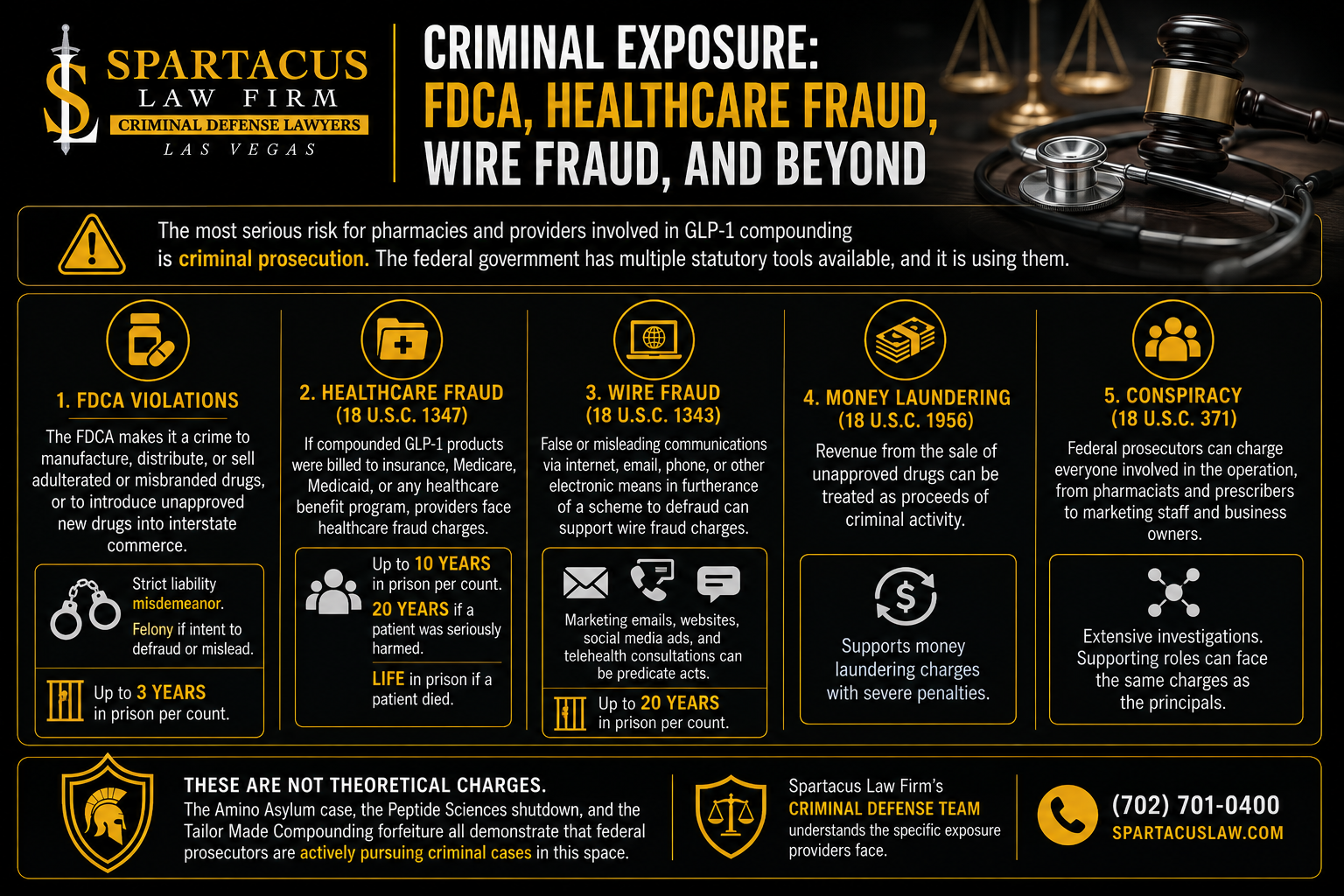
The most serious risk for pharmacies and providers involved in GLP-1 compounding is criminal prosecution. The federal government has multiple statutory tools available, and it is using them.
FDCA Violations
The Federal Food, Drug, and Cosmetic Act makes it a criminal offense to manufacture, distribute, or sell adulterated or misbranded drugs, or to introduce unapproved new drugs into interstate commerce. Compounding a drug outside the statutory exemptions of 503A or 503B is a strict liability misdemeanor. If the government proves intent to defraud or mislead, it becomes a felony carrying up to three years in prison per count. For pharmacies and providers navigating drug crime allegations, understanding these distinctions is essential.
Healthcare Fraud (18 U.S.C. 1347)
If compounded GLP-1 products were billed to insurance carriers, Medicare, Medicaid, or any other healthcare benefit program, providers face healthcare fraud charges under 18 U.S.C. 1347. Healthcare fraud is a felony carrying up to 10 years in prison per count. If a patient was seriously harmed, the penalty increases to 20 years. If a patient died, the statute authorizes life imprisonment.
Wire Fraud (18 U.S.C. 1343)
Any false or misleading communication transmitted via the internet, email, phone, or other electronic means in furtherance of a scheme to defraud can support wire fraud charges. Marketing emails, website claims, social media advertising, and telehealth consultations can all serve as the predicate acts for wire fraud prosecution. Each individual communication is a separate count, carrying up to 20 years in prison.
Money Laundering and Conspiracy
Revenue generated from the sale of unapproved drugs can be treated as proceeds of criminal activity, supporting money laundering charges under 18 U.S.C. 1956. Federal prosecutors routinely add conspiracy charges under 18 U.S.C. 371, which allows them to charge everyone involved in the operation, from pharmacists and prescribers to marketing staff and business owners. The scope of a federal conspiracy investigation can be extensive, and individuals who played supporting roles can face the same charges as the principals.
These are not theoretical charges. The Amino Asylum case, the Peptide Sciences shutdown, and the Tailor Made Compounding forfeiture all demonstrate that federal prosecutors are actively pursuing criminal cases in this space. Spartacus Law Firm’s criminal defense team understands the specific exposure providers face.
State Pharmacy Board and Medical Board Exposure
Federal enforcement is only one front. State pharmacy boards and medical boards are simultaneously investigating compounding pharmacies and prescribing providers involved in GLP-1 compounding. State board actions can result in license suspension, license revocation, probation, fines, and mandatory practice restrictions.
Board investigations may be triggered by FDA warning letters (which are public documents), patient complaints, competitor complaints, or independent board audits. Once a board investigation begins, the provider faces a parallel administrative proceeding that operates under different rules than criminal court. The burden of proof is lower, the provider’s rights are more limited, and the consequences for licensure can be career-ending.
For nurses involved in weight loss clinics or med spas that have dispensed compounded GLP-1 products, nurse license defense is a distinct and urgent concern. Similarly, pharmacist license defense requires specialized representation from attorneys who understand both the regulatory framework and the specific procedures of the Nevada State Board of Pharmacy.
The interaction between federal criminal proceedings and state board actions creates compounding risk. A federal conviction or even a federal investigation can trigger automatic board review. Statements made during a board investigation can be used in subsequent criminal proceedings if proper protections are not in place. Coordinating the defense across both tracks requires legal counsel experienced in both white collar defense and professional license defense.
What Pharmacies and Clinics Should Do Now
The enforcement landscape is clear, and the trajectory is toward more aggressive action, not less. If your pharmacy or clinic has been involved in semaglutide or tirzepatide compounding, you should take the following steps immediately.
Cease Compounding if the Shortage Exception No Longer Applies
If the FDA has resolved the drug shortage for the specific drug you are compounding, your legal basis for compounding has expired. Continuing to compound is producing unapproved drugs and exposes you to federal prosecution. Verify the current status of each product on the FDA drug shortage database and make business decisions based on the actual regulatory landscape, not on wishful interpretations.
Scrub Your Marketing Materials
Remove all references to brand names from your advertising. Remove any claims of “generic,” “bioequivalent,” “same active ingredient,” or “FDA-approved” in connection with compounded products. Archive (do not delete) all historical marketing materials, as these may be relevant to your legal defense. Have your marketing reviewed by legal counsel with experience in FDA regulatory enforcement.
Audit Your Billing Practices
If you have billed insurance, Medicare, or Medicaid for compounded GLP-1 products, conduct an internal audit of all billing claims. Inaccurate billing for compounded products is a direct pathway to healthcare fraud charges. If you identify problematic claims, consult with counsel before taking corrective action, as voluntary disclosure can mitigate penalties if handled correctly.
Retain Legal Counsel Experienced in Federal Healthcare Enforcement
This is not a situation where general business counsel is sufficient. You need attorneys who understand FDA enforcement, federal criminal prosecution, state board procedures, and the intersection of all three. The earlier you engage counsel, the more options you have. Once a federal grand jury subpoena arrives, your strategic choices narrow dramatically.
The Bottom Line
The compounded GLP-1 market is under sustained, multi-front enforcement pressure from the FDA, the Department of Justice, brand-name manufacturers, and state regulatory boards. The legal risks are not abstract. They are specific, documented, and escalating. Pharmacies and clinics that fail to adapt to the current enforcement reality face criminal prosecution, civil liability, and the loss of professional licenses.
Spartacus Law Firm has a proven track record of defending healthcare providers and businesses against exactly these types of enforcement actions. View our case results to understand the outcomes we achieve for our clients.
Protect Your Pharmacy. Protect Your License. Contact Spartacus Law Firm.
Spartacus Law Firm provides peptide and healthcare regulatory defense for compounding pharmacies, prescribing physicians, nurse practitioners, and clinic operators facing FDA investigations, federal criminal exposure, civil litigation, and state board proceedings. Attorney Chandon S. Alexander, Esq., recognized among the Top 10 Criminal Defense Attorneys Under 40 and a member of the Clark County Bar Association, the American Bar Association, and the Nevada Justice Association, brings focused experience in healthcare regulatory defense and federal criminal law.