

A letter or phone call from the Nevada State Board of Pharmacy can change the trajectory of your entire career. Whether you are a pharmacist, pharmacy technician, or pharmacy owner, a board investigation represents a direct threat to your professional license, your livelihood, and in some cases, your personal freedom. The decisions you make in the first days and weeks after learning of an investigation will shape everything that follows.
This guide explains how Nevada Board of Pharmacy investigations work from start to finish. It covers how investigations begin, what powers the board has, what rights you retain, and what defense strategies can protect your license. If you are currently under investigation or believe one may be forthcoming, this information is critical, but it is not a substitute for individualized legal counsel from an attorney who handles pharmacist license defense in Nevada.
Nevada State Board of Pharmacy: Overview and Authority
The Nevada State Board of Pharmacy is the regulatory body responsible for licensing and overseeing pharmacists, pharmacy technicians, pharmacy interns, and pharmaceutical establishments in the state. The Board operates under the authority of Nevada Revised Statutes (NRS) Chapter 639 and the Nevada Administrative Code (NAC) Chapter 639. Its primary stated mission is to protect public health and safety through the regulation of pharmacy practice.
The Board has broad investigatory and disciplinary powers. It can investigate complaints, conduct inspections, subpoena records, and impose discipline ranging from letters of concern to full license revocation. It can also refer matters to law enforcement agencies for criminal prosecution. Understanding the full scope of the Board’s authority is essential because it determines the range of outcomes you may face and the urgency with which you need to respond.
How Investigations Are Initiated
Board investigations can begin through multiple channels. Understanding where the investigation originated helps your attorney assess the likely scope of the inquiry, the evidence the Board may already possess, and whether parallel proceedings at the state or federal level are likely.
Patient Complaints
A patient or patient’s family member files a complaint alleging a dispensing error, improper counseling, unprofessional conduct, or other concern. Patient complaints are common, and many are resolved without formal discipline. However, they should never be dismissed or ignored, because the Board is obligated to investigate each one.
FDA Referrals
The FDA may refer information to the state board when it identifies concerns during inspections, product recalls, or its own enforcement activities. FDA referrals are particularly common in the compounding space. A pharmacy that draws FDA attention for compounding practices may face a simultaneous or subsequent state board investigation, creating parallel exposure at both the federal and state levels. Providers involved in peptide and healthcare regulatory matters should be especially aware of this pathway.
Board Audits and Routine Inspections
The Board conducts routine inspections of pharmacies. If an inspector identifies irregularities during a routine visit, including discrepancies in controlled substance inventories, record-keeping deficiencies, compounding standard violations, or facility issues, those findings can trigger a formal investigation. What begins as a routine inspection can quickly escalate.
DEA Referrals and Federal Agency Coordination
The Drug Enforcement Administration and other federal agencies share information with state boards. A DEA audit that reveals controlled substance discrepancies, a suspicious ordering pattern flagged by a distributor, or a federal investigation into a prescribing network can all generate referrals to the Nevada Board of Pharmacy. These cases tend to be the most serious because they often involve potential federal criminal exposure alongside the board proceedings.
Anonymous Tips and Colleague Reports
The Board accepts anonymous complaints. Disgruntled employees, business competitors, or concerned colleagues can file reports that initiate investigations. While anonymous complaints sometimes lack substance, the Board treats them with the same procedural seriousness as identified complaints.
Supply Chain Connections
When a pharmaceutical vendor, compounding supplier, or wholesale distributor comes under federal investigation, every pharmacy and provider in that vendor’s customer network becomes a person of interest. The federal agency investigating the vendor will typically share customer lists with state boards, and the state boards will open investigations into each customer pharmacy. This has become increasingly common in the peptide compounding space, where federal actions against bulk peptide suppliers have triggered cascading state board investigations against pharmacies that purchased from those suppliers.
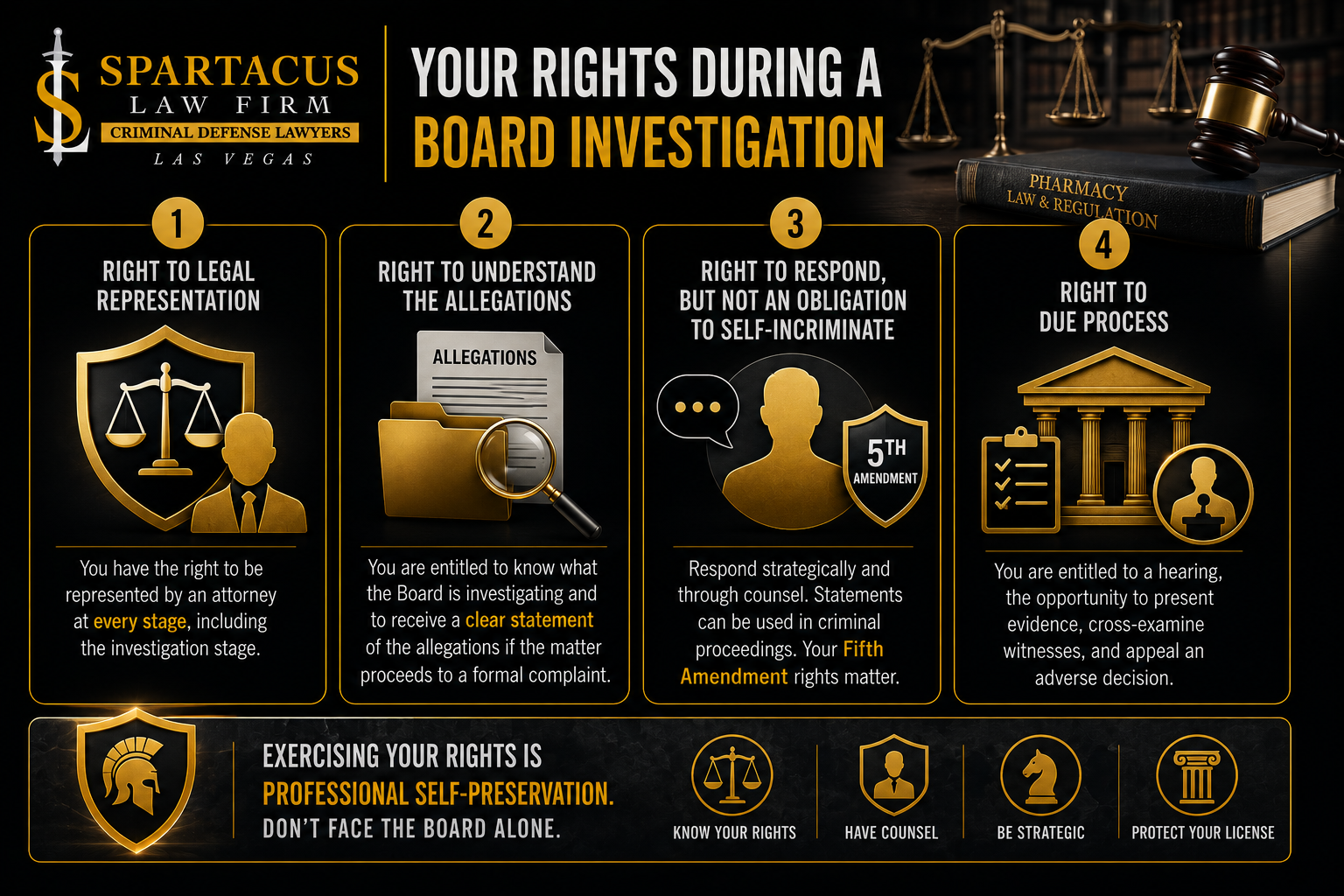
Your Rights During a Board Investigation
Pharmacists and pharmacy technicians retain important rights during board investigations. Exercising these rights is not obstruction, it is professional self-preservation. Failing to exercise them can result in statements, admissions, or document productions that strengthen the Board’s case against you.
- Right to legal representation. You have the right to be represented by an attorney at every stage of the process. This includes the investigation stage, not just the hearing stage. Engaging a professional license defense attorney early in the process is the single most important step you can take.
- Right to understand the allegations. You are entitled to know what the Board is investigating. While the Board does not always disclose the full scope of its inquiry at the outset, you have the right to receive a clear statement of the allegations if and when the matter proceeds to a formal complaint.
- Right to respond, but not an obligation to self-incriminate. You can respond to Board inquiries, but you should do so strategically and through counsel. Unguided responses to Board investigators are one of the most common mistakes pharmacists make. Statements made during a board investigation can be used in subsequent criminal proceedings. If there is any possibility of parallel criminal exposure, your Fifth Amendment rights must be carefully considered.
- Right to due process. If the Board proceeds to a formal complaint, you are entitled to a hearing, the opportunity to present evidence, the right to cross-examine witnesses, and the right to appeal an adverse decision.
The Investigation Timeline
Board investigations do not follow a fixed schedule, and the timeline varies significantly depending on the complexity of the case. Understanding the general range helps you and your attorney plan an effective defense strategy.
Straightforward cases, such as a single dispensing error with a clear factual record, may be resolved in three to six months from the initial complaint to final disposition. These cases often involve limited document review, a small number of witnesses, and no parallel proceedings.
Complex cases can take well over a year. Cases involving controlled substance diversion, compounding violations with multiple affected patients, or parallel federal investigations routinely extend beyond twelve months. Cases connected to federal investigations into compounding pharmacies, drug distribution networks, or bulk peptide suppliers can take even longer, because the state board often waits for federal proceedings to reach a certain stage before advancing its own case.
During this entire period, the investigation remains open. The uncertainty itself becomes a burden, affecting your ability to plan, your professional standing, and in some cases, your ability to practice. This is another reason early attorney engagement matters: an experienced attorney can sometimes accelerate resolution by proactively engaging with the Board and addressing concerns before they solidify into formal charges.
Types of Actions the Board Can Take
Not every investigation results in formal discipline. The Board has a range of tools at its disposal, and the outcome depends on the severity of the allegations, the strength of the evidence, your cooperation and response, and any mitigating factors your attorney can present.
Informal Resolution
Some investigations conclude without any formal action. The Board may determine that the complaint is unsubstantiated, that the conduct in question does not warrant discipline, or that the pharmacist has already taken corrective action. Informal resolution is the best possible outcome, and it is often achievable when an attorney intervenes early with a well-prepared response.
Letter of Concern
A letter of concern is a written communication from the Board identifying conduct that fell below expected standards but does not rise to the level of formal discipline. While not technically disciplinary, a letter of concern becomes part of your Board file and can influence the Board’s response to any future complaints.
Consent Agreement
A consent agreement is a negotiated resolution between the pharmacist and the Board. The pharmacist agrees to specific terms, which may include continuing education, practice restrictions, monitoring, or other conditions, in exchange for avoiding a formal hearing. Consent agreements are public records and do constitute discipline, but they allow the pharmacist to maintain their license and avoid the risks of a contested hearing.
Formal Complaint
If the Board determines that the evidence supports formal discipline and the matter cannot be resolved informally or through a consent agreement, it will file a formal complaint. This initiates the administrative hearing process described below.
The Formal Complaint and Hearing Process
When the Board files a formal complaint, the case enters a structured legal proceeding that closely resembles a trial.
- Notice of Hearing. You will receive a formal Notice of Hearing that identifies the specific allegations against you, the statutes or regulations you are alleged to have violated, and the date, time, and location of the hearing. This notice triggers deadlines for filing responses and exchanging evidence.
- Administrative hearing. The hearing is conducted before a hearing officer. Both sides present evidence, call witnesses, and make legal arguments. The rules of evidence in administrative proceedings are more relaxed than in criminal court, which means the Board can often introduce evidence that might be excluded in a criminal trial. This cuts both ways, but it underscores the importance of having an attorney who understands administrative hearing procedure.
- Board review. After the hearing officer issues findings and recommendations, the full Board reviews the record and makes the final disciplinary decision. The Board is not bound by the hearing officer’s recommendations and can impose more or less severe discipline than recommended.
Potential Outcomes of Board Discipline
The range of disciplinary outcomes includes the following, from least to most severe.
- Dismissal. The Board can dismiss the formal complaint entirely if it finds the allegations unsupported.
- Letter of reprimand. A formal written reprimand that becomes part of your permanent Board file.
- Probation with conditions. Your license remains active but is subject to conditions such as practice monitoring, random drug testing (in cases involving substance abuse), supervision requirements, or reporting obligations. Probation terms typically range from one to five years.
- Suspension. Your license is suspended for a defined period. You cannot practice pharmacy during the suspension. Reinstatement may require meeting specific conditions.
- Revocation. Your license is permanently revoked. Revocation is the most severe outcome and is generally reserved for the most serious violations, including those involving patient harm, controlled substance diversion, fraud, or felony convictions.
- Fines. The Board can impose monetary fines in addition to or in lieu of other discipline.
Mandatory continuing education and practice restrictions. The Board can require completion of specific continuing education courses or impose restrictions on the type of pharmacy practice you can engage in.
How Discipline Follows You: National Databases and Interstate Impact
Board discipline does not stay in Nevada. Disciplinary actions are reported to the National Practitioner Data Bank (NPDB) and to state verification systems that other state boards access when processing license applications, renewals, and transfers. This means that discipline imposed by the Nevada Board of Pharmacy will follow you to any other state where you hold or seek a pharmacy license.
Other state boards are required to review NPDB reports when considering license applications, and many boards treat out-of-state discipline as grounds for reciprocal action. A consent agreement or probation in Nevada can result in equivalent or additional discipline in every other state where you are licensed. For pharmacists who hold licenses in multiple states, a single Nevada proceeding can cascade into multi-state license jeopardy. This multi-jurisdictional exposure applies to other healthcare professionals as well, including nurses facing board proceedings.
The Connection Between State Board Proceedings and Federal Investigations
One of the most dangerous aspects of a Nevada Board of Pharmacy investigation is its potential connection to federal proceedings. Parallel state and federal proceedings are increasingly common, particularly in the peptide and compounding space.
The relationship works in both directions. A board investigation can trigger a DOJ referral if the Board’s investigation uncovers evidence of federal violations, such as introducing unapproved drugs into interstate commerce, controlled substance diversion, healthcare fraud, or violations of the Food, Drug, and Cosmetic Act. The Board is not required to notify you before making such a referral, and in many cases, you will not learn of the federal investigation until after it has been underway for months.
Conversely, a federal investigation can trigger a board complaint. When the DOJ, FDA, or DEA investigates a pharmacy or pharmacist, those agencies routinely share information with the relevant state board. The board then opens its own investigation based on the federal information. The result is that you face two simultaneous proceedings with different rules, different standards of proof, and different potential penalties, but where your statements and actions in one proceeding can affect the other.
This is why having an attorney who handles both criminal defense and professional license defense is essential in these cases. Responding to a board investigation without considering potential federal exposure, or defending a federal case without accounting for board implications, can produce disastrous results in one or both proceedings.

How Early Attorney Intervention Changes Outcomes
The most effective time to engage an attorney in a board investigation is before you respond to the Board’s initial inquiry. Every communication with the Board, every document you produce, and every statement you make shapes the trajectory of the case. Once damaging admissions are made or problematic documents are produced, they cannot be retracted.
Early attorney intervention can change outcomes in several concrete ways. Your attorney can assess whether the matter involves potential criminal exposure and advise you on how to balance cooperation with self-protection. Your attorney can prepare a comprehensive written response that addresses the Board’s concerns while protecting your interests. Your attorney can engage directly with the Board’s investigator or prosecutor to negotiate resolution before formal charges are filed. And your attorney can begin building the evidentiary record for your defense, including gathering favorable evidence, identifying expert witnesses, and preserving documentation that may be relevant.
Many cases that result in formal discipline could have been resolved informally or through more favorable consent agreements if the pharmacist had retained counsel earlier in the process. The cost of early legal intervention is almost always less than the cost of defending a formal complaint, and it is a fraction of the cost of losing your license.
Nevada Pharmacy Board Defense Strategies
Effective defense of a pharmacy board investigation requires a strategy tailored to the specific facts, the source of the investigation, and the potential outcomes. Several approaches have proven effective in Nevada pharmacy board cases.
- Proactive compliance remediation. Demonstrating that you have already identified and corrected the issues that prompted the investigation sends a powerful message to the Board. This can include implementing new standard operating procedures, upgrading record-keeping systems, obtaining additional training, or engaging compliance consultants.
- Expert testimony. In cases involving allegations of substandard practice, expert testimony from pharmacists or other professionals who can speak to applicable standards of care and industry norms can be decisive. Standards in compounding pharmacy, in particular, are evolving rapidly, and what the Board characterizes as a violation may in fact be consistent with accepted practice.
- Challenging the Board’s evidence. Administrative proceedings have evidentiary rules, and the Board’s evidence is not automatically admissible or credible. Challenging the reliability of inspection reports, the qualifications of Board investigators, or the interpretation of records can undermine the Board’s case. Cases involving white collar allegations often turn on how records and transactions are interpreted.
- Negotiated resolution. When the facts support it, negotiating a consent agreement that allows you to maintain your license with manageable conditions is often preferable to the uncertainty of a contested hearing. Effective negotiation requires understanding what the Board is likely to accept and presenting compelling reasons for a favorable resolution.
- Constitutional and procedural defenses. Board investigations must comply with due process requirements. If the Board has violated your procedural rights, failed to follow its own regulations, or relied on evidence obtained through improper means, these issues can be raised as defenses.
Your Pharmacy License Is Your Career. Defend It Aggressively.
A Nevada Board of Pharmacy investigation is not a routine administrative matter. It is a direct threat to the license that makes your career possible. The pharmacists who protect their licenses are the ones who take the investigation seriously from day one and engage experienced legal counsel before making any statements or producing any documents.
Spartacus Law Firm provides aggressive pharmacist license defense and criminal defense for Nevada pharmacists facing board investigations, federal inquiries, and parallel proceedings. Learn more about our firm and Attorney Chandon S. Alexander, recognized among the Top 10 Criminal Defense Attorneys Under 40, and a member of the Clark County Bar Association, the ABA, and the Nevada Justice Association.
Contact Spartacus Law Firm today for a confidential consultation. We are available 24/7 at (702) 660-1234, with offices in Downtown Las Vegas (400 S 7th Street, Suite 100, Las Vegas, NV 89101) and Howard Hughes Center (3993 Howard Hughes Parkway, Suite 480, Las Vegas, NV 89169). Do not wait for the Board to make the next move.