


If you are a compounding pharmacy, prescribing physician, or clinic operator who has been watching the regulatory landscape around BPC-157, the past twelve months have been defined by confusion. Headlines announcing that the FDA removed BPC-157 from its Category 2 list in April 2026 created a wave of optimism across the regenerative medicine community. Providers began fielding patient questions about when they could resume offering BPC-157 therapy. Some pharmacies quietly resumed compounding.
That optimism is premature, and potentially dangerous. The removal of BPC-157 from Category 2 did not authorize compounding. It did not place the peptide on the approved bulks list. And the FDA’s most recent actions, including its July 2026 briefing documents to the Pharmacy Compounding Advisory Committee (PCAC), make clear that the agency views BPC-157 as a substance without adequate evidence of safety or effectiveness for human use. If you are compounding, dispensing, or prescribing BPC-157 today, you are operating in a regulatory gray area that carries real enforcement risk.
This guide breaks down exactly where the law stands, what the FDA has done, and what the recent enforcement actions against compounders and peptide suppliers mean for your practice or pharmacy. If you are already facing a regulatory inquiry or investigation, contact Spartacus Law Firm immediately.
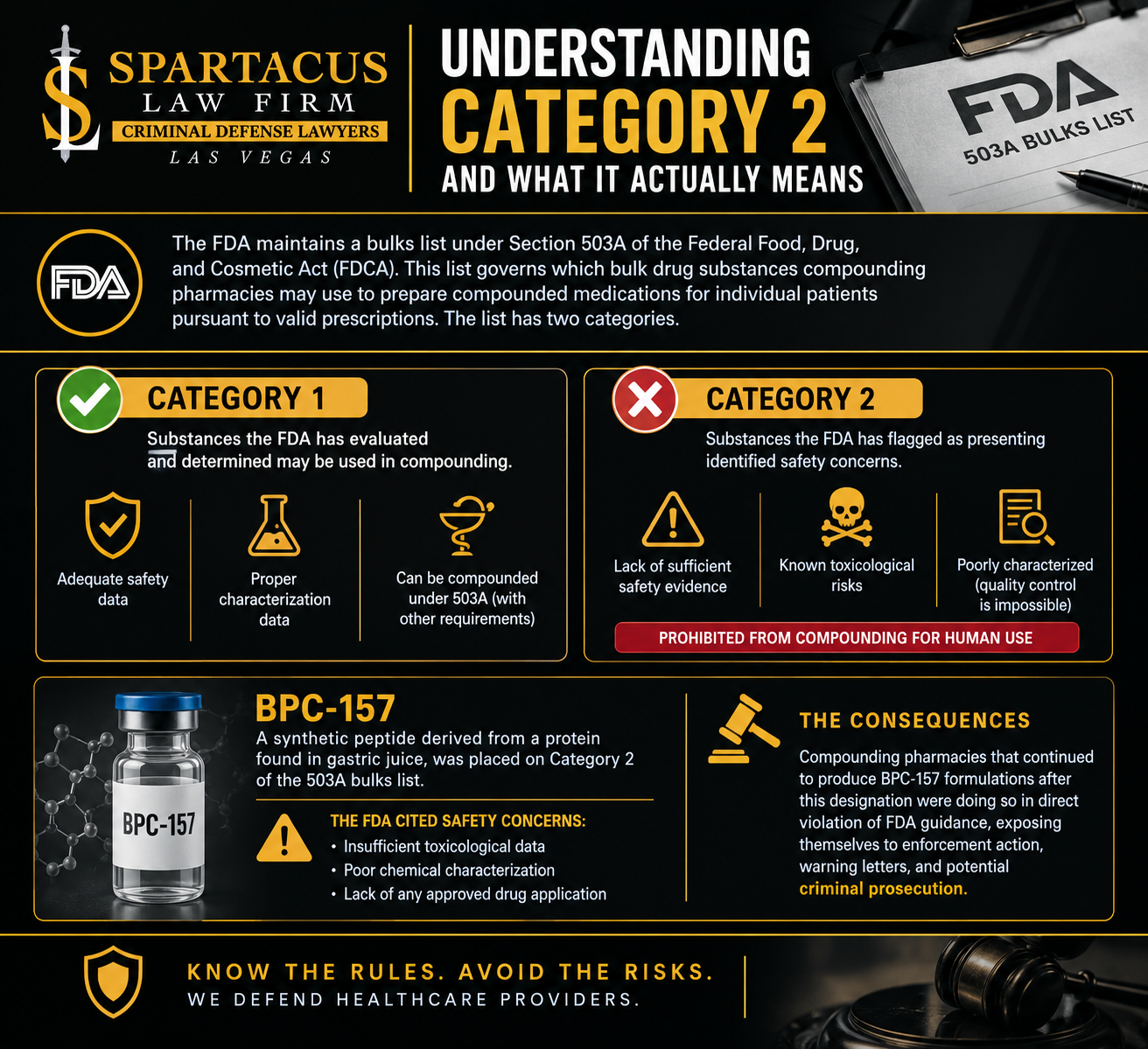
Understanding Category 2 and What It Actually Means
The FDA maintains a bulks list under Section 503A of the Federal Food, Drug, and Cosmetic Act (FDCA). This list governs which bulk drug substances compounding pharmacies may use to prepare compounded medications for individual patients pursuant to valid prescriptions. The list has two categories.
- Category 1 includes substances that the FDA has evaluated and determined may be used in compounding. These substances have adequate safety and characterization data. If a bulk drug substance appears on Category 1, pharmacies can generally compound with it under 503A, subject to the other requirements of the statute.
- Category 2 includes substances the FDA has flagged as presenting identified safety concerns. Substances placed on Category 2 are prohibited from compounding for human use. The FDA created this category specifically to prevent pharmacies from compounding with substances that lack sufficient evidence of safety, have known toxicological risks, or are so poorly characterized that meaningful quality control is impossible.
BPC-157, a synthetic peptide derived from a protein found in gastric juice, was placed on Category 2 of the 503A bulks list. The FDA cited safety concerns, including insufficient toxicological data, poor chemical characterization, and the lack of any approved drug application involving BPC-157. Compounding pharmacies that continued to produce BPC-157 formulations after this designation were doing so in direct violation of FDA guidance, exposing themselves to enforcement action, warning letters, and potential criminal prosecution.
What Happened in April 2026: The Removal That Was Not an Approval
In April 2026, the FDA removed twelve peptides, including BPC-157, from Category 2 of the 503A bulks list. This decision was widely reported by peptide industry outlets and health media as a positive development. Some coverage implied, or outright stated, that BPC-157 was now legal to compound.
That interpretation is wrong.
Removing a substance from Category 2 means only that the FDA has chosen not to continue designating it as a substance with identified safety concerns under that specific list. It does not mean the substance has been added to Category 1. It does not mean the FDA has evaluated the substance and found it safe. And it does not mean compounding is authorized.
To be clear: BPC-157 currently sits in a regulatory gap. It is not on Category 1 (approved for compounding). It is no longer on Category 2 (prohibited due to safety concerns). It is not an FDA-approved drug. There is no approved New Drug Application (NDA) or Abbreviated New Drug Application (ANDA) for any BPC-157 product. This means any pharmacy compounding BPC-157 is producing an unapproved drug, which is a violation of federal law unless it falls within one of the narrow statutory exemptions, and the absence of the substance from both Category 1 and Category 2 makes that exemption argument extremely difficult to sustain.
For providers and pharmacies navigating peptide and healthcare regulatory defense issues, understanding this distinction is critical.
The PCAC Review: July 23-24, 2026
The FDA’s Pharmacy Compounding Advisory Committee (PCAC) convened on July 23-24, 2026, to review several bulk drug substances, including BPC-157. The committee was specifically tasked with evaluating whether BPC-157 should be nominated for the Category 1 bulks list for a proposed ulcerative colitis indication.
The FDA’s own briefing documents, prepared by agency staff and published ahead of the meeting, recommended against easing restrictions on BPC-157 compounding. The agency’s analysis cited several concerns:
- Insufficient evidence of safety and effectiveness. The FDA noted that no adequate and well-controlled clinical trials have been conducted in humans. The animal study data that exists does not meet the standards the agency requires to evaluate safety for human use.
- Poor chemical characterization. BPC-157 is a synthetic peptide, and the FDA found that the available data did not adequately characterize the substance’s identity, purity, potency, and stability. Without reliable characterization, compounding pharmacies cannot ensure that what they produce is consistent, pure, or dosed correctly.
- Immunogenicity risks. The FDA raised concerns about the potential for BPC-157 to trigger immune responses in patients. Peptides can provoke antibody formation, allergic reactions, or other immunological events, and the absence of adequate immunogenicity testing means these risks are unquantified.
The PCAC meeting is an advisory function. The committee’s recommendations are not binding on the FDA. But the direction of the agency’s briefing documents signals clearly that the FDA does not view BPC-157 as a substance ready for Category 1 inclusion. Providers who assume the regulatory environment is moving toward permissiveness are misreading the situation.
FDA Enforcement Is Not Hypothetical: Recent Cases
The FDA has backed its regulatory position with aggressive enforcement actions. In the past eighteen months, multiple compounding operations and peptide suppliers have faced federal prosecution, asset forfeiture, and civil penalties. These are not theoretical risks. They are active, ongoing cases.
Tailor Made Compounding: $1.79 Million Forfeiture
Tailor Made Compounding, one of the largest 503B outsourcing facilities in the country, forfeited $1.79 million in connection with federal enforcement action. The case involved allegations that the company produced and distributed compounded drug products that did not comply with FDA requirements. Tailor Made’s case illustrates that even large, established compounding operations are not insulated from enforcement.
Amino Asylum: Criminal Guilty Pleas
In December 2025, the founders of Amino Asylum, a well-known online peptide and research chemical supplier, pleaded guilty to federal drug crimes charges. Amino Asylum had operated for years selling peptides, including BPC-157, marketed as research chemicals. The guilty pleas confirmed that the federal government views the sale of unapproved peptide products for human use as criminal conduct, regardless of how the products are labeled or marketed.
Peptide Sciences: Shut Down March 2026
Peptide Sciences, another major supplier of research peptides, was shut down in March 2026. The closure followed sustained federal pressure on peptide suppliers operating outside the approved pharmaceutical framework. Peptide Sciences had been a primary source for clinics and individual consumers obtaining BPC-157 and other peptides.
50+ FDA Warning Letters to GLP-1 Compounders
In September 2025, the FDA issued more than 50 warning letters to compounding pharmacies involved in producing GLP-1 receptor agonist formulations. While these warning letters targeted semaglutide and tirzepatide compounders specifically, they established a template for FDA enforcement across the compounding industry. The warning letters focused on false and misleading marketing claims, production of unapproved drugs, and failure to comply with Current Good Manufacturing Practice (CGMP) requirements. These same theories of enforcement apply directly to BPC-157 compounders.
If you are facing investigation or enforcement related to compounding activity, you should speak with a professional license defense attorney and a white collar crimes defense lawyer immediately.

What Providers and Pharmacies Should Do Right Now
The regulatory environment around BPC-157 is not settled. It is actively evolving, and the trajectory of FDA enforcement suggests increasing, not decreasing, scrutiny. If you are a prescribing physician, compounding pharmacist, or clinic operator who has been involved with BPC-157, here is what you need to do.
Audit Your Current Operations
If you are currently compounding or dispensing BPC-157, conduct an immediate internal audit. Identify every product you have compounded, every prescription you have filled, every patient who has received BPC-157 therapy, and every marketing claim you have made about the substance. Document everything. This audit should be conducted under the direction of legal counsel so that attorney-client privilege applies.
Stop Making Public Claims About BPC-157 Legality
Do not represent to patients, on your website, or in advertising that BPC-157 is legal, FDA-approved, or authorized for compounding. These claims are false, and they create evidence that regulators and prosecutors can use against you. If you have existing marketing materials that reference BPC-157, pull them immediately and preserve copies for your legal team.
Evaluate Your Supplier Relationships
If you have been sourcing BPC-157 from suppliers that operate outside the registered pharmaceutical supply chain, those relationships are a liability. Federal investigators routinely trace supply chains, and purchasing from unregistered suppliers compounds your exposure. Doctor license defense and pharmacist license defense cases frequently turn on the source and quality of the substances involved.
Understand Your Criminal Exposure
Compounding and distributing unapproved drugs is a federal crime under the FDCA. Depending on the facts, providers and pharmacists may also face charges for healthcare fraud (18 U.S.C. 1347), wire fraud (18 U.S.C. 1343), money laundering, and conspiracy. These are felony charges that carry significant prison terms. The Amino Asylum guilty pleas and the Tailor Made forfeiture demonstrate that the Department of Justice is actively prosecuting these cases.
Engage Legal Counsel Before You Receive a Subpoena
The worst time to find a lawyer is after federal agents arrive with a search warrant or subpoena. If you have been involved in BPC-157 compounding, prescribing, or distribution in any capacity, consult with a healthcare regulatory defense attorney now. Early legal intervention can shape the outcome of an investigation before charges are filed.
The Bottom Line
BPC-157 is not legal to compound for human use. The removal of BPC-157 from Category 2 did not authorize compounding. The FDA’s PCAC briefing documents recommended against easing restrictions. Federal enforcement actions against peptide suppliers and compounders are accelerating. And the agency has demonstrated its willingness to pursue criminal prosecution, asset forfeiture, and regulatory sanctions against individuals and businesses involved in the peptide compounding space.
The question is not whether the FDA will continue enforcement. The question is whether you will be prepared when it reaches your practice or pharmacy.
Protect Your Practice. Contact Spartacus Law Firm Today.
Spartacus Law Firm provides peptide and healthcare regulatory defense representation for physicians, pharmacists, compounding pharmacies, and clinic operators facing FDA investigations, state board inquiries, and federal criminal exposure. Attorney Chandon S. Alexander, Esq., recognized among the Top 10 Criminal Defense Attorneys Under 40 and a member of the Clark County Bar Association, the American Bar Association, and the Nevada Justice Association, understands the intersection of healthcare regulation and criminal law.
Two Las Vegas locations:
- Downtown: 400 S 7th Street, Suite 100, Las Vegas, NV 89101
- Howard Hughes: 3993 Howard Hughes Parkway, Suite 480, Las Vegas, NV 89169
Contact Spartacus Law Firm to schedule a confidential consultation.